S16. Workflow Runtime — Scripts Own Fixed Orchestration
S16. Workflow Runtime — Scripts Own Fixed Orchestration
From s01 through s15, the model decides which tools to call in each round. Their results enter messages[], and the model decides the next step from the updated context. This works well when the path depends on what the previous step discovers.
Some tasks repeat a fixed sequence. A code review may inspect several dimensions concurrently, verify each finding, combine duplicates, and sort the result. The sequence and dependencies are known before execution. Here the host needs three things:
- Parallelism, rather than waiting for one item at a time;
- A stable result structure, even when individual agent answers vary;
- Recoverability, so an interruption does not rerun work that is already complete.
If this orchestration exists only in conversation history, its ordering and checkpoints also exist only in that history. A saved workflow puts the fixed sequence in code and records completed calls in a journal.
Put the Plan in Code, Not in a Sequence of Chat Turns
Add a Workflow tool to the harness tool pool. The host registers trusted scripts built from agent(), parallel(), pipeline(), and phase(). The model supplies only a saved workflow name, arguments, and an optional run ID to resume; it does not send executable code or metadata.
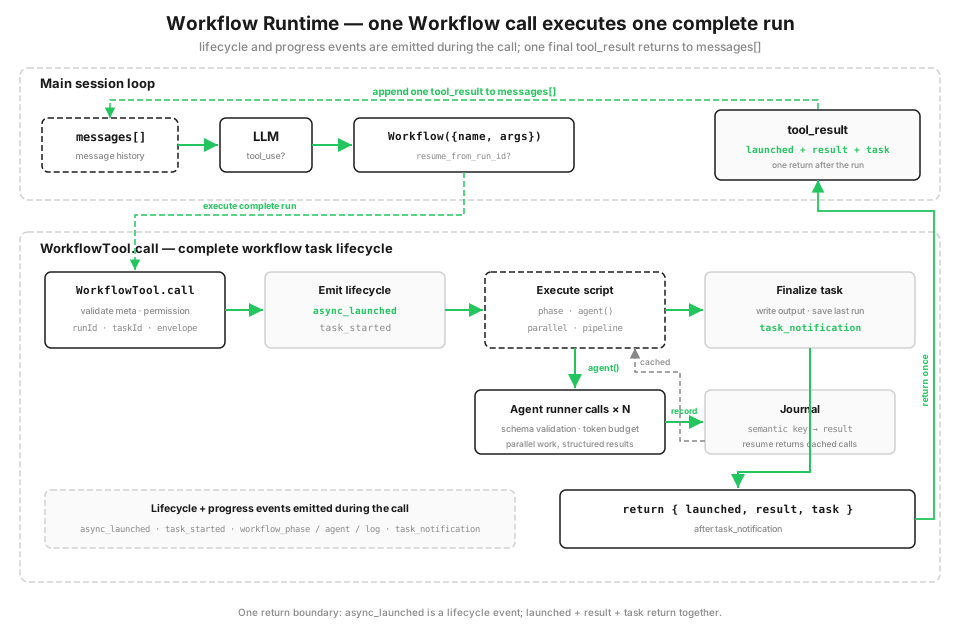
The workflow enters the main loop as one tool_use. As the script runs, the runtime emits lifecycle and progress events and records every step in a journal on disk. When the script finishes, the call returns the launch envelope, result, and task state. Intermediate script results live in variables instead of taking space in conversation history. When restarted with resume_from_run_id, unchanged agent() calls hit the journal cache and reuse previous results.
SAMPLE_META = {"name": "review-changes", "description": "Review code changes", "phases": ["Review", "Verify"]}

async def sample_workflow(ctx, args):
    ctx.phase("Review")
    results = await ctx.pipeline(DIMENSIONS, audit, verify)   # Each dimension independently runs audit → verify
    confirmed = [f for r in results if r for f in r["confirmed"]]
    ctx.log(f"Confirmed {len(confirmed)} real issues")
    return {"confirmed": confirmed}
The Workflow Tool: One Call, One Complete Run
Workflow is added to the s15 host's existing tool pool. The user can request a saved workflow, or the model can select it when a task matches a known orchestration. The adapter resolves the name through the host-owned WORKFLOWS registry, then passes its trusted metadata and function to the runtime. The other s15 tools remain available in the same loop.
The model-facing schema accepts name, args, and resume_from_run_id. Unknown names and malformed arguments become an error tool result instead of ending the host loop. The runtime then validates the registered metadata, checks permissions, registers a local workflow task, and emits async_launched before running the script. Progress events follow, then the final task_notification; the call returns JSON-safe launch information, result, and task state.
WORKFLOW_TOOL = {
    "name": "Workflow",
    "input_schema": {
        "type": "object",
        "properties": {
            "name": {"type": "string"},
            "args": {"type": "object"},
            "resume_from_run_id": {"type": "string"},
        },
        "required": ["name"],
        "additionalProperties": False,
    },
}

async def run_workflow(name, args=None, resume_from_run_id=None):
    meta, script_fn = WORKFLOWS[name]
    out = await WorkflowTool().call(
        meta, script_fn,
        args=args,
        resume_from_run_id=resume_from_run_id,
    )
    return {"launched": out["launched"], "result": out["result"],
            "task": serialize_task(out["task"])}
Workflow Metadata: Validate Before Launch
Each saved workflow registers trusted metadata with name, description, and optional phases. The runtime validates it before executing workflow code. name and description identify the task in the UI, while phases names groups in the progress display. These fields belong to the host registry, not to model input.
Invalid registration raises WorkflowInputError before launch. This is the same idea as validating cron expressions in s12: do not wait until execution to discover a bad saved workflow.
Because the runtime uses meta.name in local artifact filenames, it also requires a 1-64 character safe slug containing letters, numbers, ., _, or -.
def validate_meta(meta):
    if not isinstance(meta, dict):
        raise WorkflowInputError("meta must be an object literal")
    if not meta.get("name") or not meta.get("description"):
        raise WorkflowInputError("meta requires name and description")
    if not isinstance(meta["name"], str) or not WORKFLOW_NAME_RE.fullmatch(meta["name"]):
        raise WorkflowInputError("meta.name must be a safe 1-64 character slug")
    if "phases" in meta and (
        not isinstance(meta["phases"], list)
        or not all(isinstance(p, str) and p for p in meta["phases"])
    ):
        raise WorkflowInputError("meta.phases must contain non-empty strings")
    return meta
Orchestration Primitives
A script receives an ExecutionState exposing a small set of orchestration primitives. It does not read files or run shell commands directly. The default interactive mode connects agent() to the same real API client as the host, and each workflow agent reads only the content supplied through workflow arguments. demo and unit tests use MockAgentRunner so events and journal replay are repeatable.
| Primitive | Purpose | |------|------| | agent(prompt, {schema, label, phase}) | Dispatch one subagent | | parallel(thunks) | Barrier: run every task concurrently and wait until all results return | | pipeline(items, *stages) | Run each item through stages without a barrier; finished items proceed immediately | | phase(title) | Mark the current progress phase and update the progress display | | log(message) | Emit a progress log line | | workflow(name, args) | Run a nested sub-workflow, one level only |
Use pipeline when each item independently crosses the same stages. Item A may reach stage three while item B is still in stage one. Use parallel when the next step needs every result from the preceding group.
async def pipeline(self, items, *stages):
    async def run_item(item, idx):
        value = item
        for stage in stages:                       # Each item independently completes every stage
            value = await stage(value, item, idx)
        return value
    return await asyncio.gather(*[run_item(it, i) for i, it in enumerate(items)])
Structured Output: Do Not Let Subagents Return Essays
agent({schema}) asks a workflow agent to return only a JSON object matching the schema. The runtime parses and validates the result, then retries once if it does not match. Downstream code receives an object instead of extracting fields from prose.
s05 warned that tool arguments cannot be trusted completely. This is the same lesson in reverse: subagent output cannot be trusted completely either. Validate at the orchestration boundary, give one retry, and keep uncertainty out of the rest of the flow.
run = await asyncio.to_thread(self.runner.run, prompt, schema, label)
result = run.value
if schema is not None:
    ok, err = SimpleJsonSchema(schema).validate(result)
    if not ok:                                       # Retry once with a reminder, then fail
        retry = await asyncio.to_thread(
            self.runner.run, prompt + "\n\nReturn valid JSON.", schema, label
        )
        result = retry.value
        ok, err = SimpleJsonSchema(schema).validate(result)
        if not ok:
            raise WorkflowInputError(f"agent({{schema}}) returned invalid output: {err}")
Task State and Progress Events
LocalWorkflowTask maintains status and token usage and emits an SDK-style event stream: task_started → a sequence of task_progress events containing phase changes, subagent starts, and log batches → one final task_notification reporting completion or failure, plus the output file and agent and token counts.
The demo prints these events in order and returns the task state after the final notification.
class LocalWorkflowTask:
    def progress_event(self, ptype, **data):         # Phase/subagent/log
        self.progress.append({"type": ptype, **data})
        print(f"  progress   {ptype} ...")
Storage: Snapshot + Journal for Resuming after Interruptions
The runtime stores each run under s16_workflow_runtime/.runtime/: a <runId>.json snapshot, <runId>.output.json output, <runId>.journal.jsonl journal, and <runId>.lock coordination file. Every fresh run reserves a new runId with exclusive file creation before opening its journal. The run lock stays held through execution and final persistence, so another process cannot resume the same run at the same time. Its snapshot records the workflow name, arguments, and task state; resume validates the saved snapshot and journal before changing either successful artifact.
The journal is the core of checkpointed resume. It records every agent() result one line at a time:
class WorkflowJournal:
    def record(self, key, value):
        self._f.write(json.dumps({"key": key, "value": value}) + "\n")
        self._f.flush()
        self.cache[key] = value
Resume: Continue by runId and Reuse Everything Unchanged
Calling the workflow again with resume_from_run_id reruns the script, but every agent() computes a deterministic semantic key. If that key is present in the journal, it returns the cached result without executing again. Every unchanged call hits the cache; only a changed call and the downstream steps that depend on it actually rerun.
The key detail is that keys cannot depend on concurrency order. Agents in parallel and pipeline finish in nondeterministic order. If "the nth completion" became the key, cache entries would map to the wrong calls on the next run. A key therefore uses a stable hash of call content, including type, label, prompt, and schema, rather than a shared counter:
def key(self, kind, label, prompt, schema):
    basis = f"{kind}|{label}|{prompt}|{json.dumps(schema, sort_keys=True)}"
    return f"{kind}-{_stable_hash(basis) % 10**10:010d}"

# Inside agent():
cached = self.journal.cached(key)
if cached is not MISS:
    self.task.progress_event("workflow_agent", label=label, status="cached")
    return cached
Stable Call Keys
On resume, the runtime must match each current agent() call with its earlier journal record. A stable hash gives unchanged workflow code and arguments the same call key. Real model output may vary; when the call content has not changed, resume uses the result already saved in the journal.
See It Run
The sample review-changes workflow uses pipeline to send each review dimension independently through audit → verify. Interactive mode uses the real API and reads the material to review from args.changes. demo uses fixed runner data to show pipeline, validation, journal, and resume behavior.
async def sample_workflow(ctx, args):
    ctx.phase("Review")
    changes = args.get("changes", "")

    async def audit(_v, dimension, _i):
        out = await ctx.agent(f"Inspect this change for {dimension} issues:\n{changes}",
                              schema=FINDINGS_SCHEMA, label=f"audit:{dimension}", phase="Review")
        return {"dimension": dimension, "findings": out["findings"]}

    async def verify(audited, dimension, _i):
        ctx.phase("Verify")
        verdicts = await ctx.parallel([                       # Verify every finding independently
            (lambda f=f: ctx.agent(f"Verify this finding against the change:\n{changes}\n\n{f}",
                                   schema=VERDICT_SCHEMA, label=f"verify:{dimension}:{f['title']}"))
            for f in audited["findings"]])
        return {"dimension": dimension,
                "confirmed": [f for f, v in zip(audited["findings"], verdicts) if v and v["isReal"]]}

    results = await ctx.pipeline(DIMENSIONS, audit, verify)
    ...
Changes from s15
| | s15 Integrated Harness | s16 Workflow Runtime | |--|-----------|---------------------| | Loop | One model-driven loop | Main loop unchanged; a tool runs scripted orchestration | | Who decides the next step | Model decides each round | Script declares the orchestration in advance | | Multiple agents | One-shot s06 subagents | Scripted, resumable calls through an agent-runner boundary | | New mechanisms | — | Script primitives, host registry and tool adapter, task lifecycle, progress events, journal/resume, structured output |
s16 does not replace the main loop. It exposes Workflow at the tool layer and starts a local workflow runtime behind it: one saved script coordinates N calls through an agent-runner boundary. An s06 subagent is dispatched once at the model's discretion; s16 turns the orchestration into resumable host code.
Try It
python s16_workflow_runtime/code.py          # Both the main model and Workflow agents use the real API
python s16_workflow_runtime/code.py demo     # Deterministic review-changes fixture and event stream
python s16_workflow_runtime/code.py resume   # Resume by the last runId; every agent() hits the journal cache
In the default command, ask the model to read the changes, place that text in args.changes, and run the saved review-changes workflow. Both the main model and workflow agents use the real API. The demo command uses fixed runner data so lifecycle and resume behavior can be observed repeatedly. A resumed demo reports agents=0 tokens=0 when every call hits the cache.
Next
s17 Goal Loop uses a smaller, independent loop to check whether a stated goal has been reached and decide whether another turn is needed.
S16 — Complete teaching code
#!/usr/bin/env python3
"""
s16: Workflow Runtime - run a saved orchestration through one tool call.
Run:
python s16_workflow_runtime/code.py
python s16_workflow_runtime/code.py demo
python s16_workflow_runtime/code.py resume
+-------------+ +--------------------------------+
| Agent loop | ----> | Workflow(name, args, run_id) |
+-------------+ +---------------+----------------+
|
+--------------+--------------+
| agent | parallel | pipeline |
+--------------+--------------+
|
journal + result
"""
import asyncio
import fcntl
import hashlib
import importlib.util
import json
import os
import re
import secrets
import sys
import threading
from contextlib import contextmanager
from dataclasses import dataclass
from pathlib import Path
# -- Runtime Guards --
AGENT_CAP = 1000 # hard cap on agent() calls per run
CONCURRENCY = 8 # parallelism cap (semaphore)
STORE = Path(__file__).parent / ".runtime" # snapshots + journals live here
MISS = object() # journal cache miss sentinel
WORKFLOW_NAME_RE = re.compile(r"^[A-Za-z0-9][A-Za-z0-9._-]{0,63}$")
RUN_ID_RE = re.compile(r"^wf_[A-Za-z0-9][A-Za-z0-9._-]{0,63}_[0-9a-f]{16}$")
def _stable_hash(s: str) -> int:
"""Process-stable hash (Python's hash() is salted per process, which would
break resume keys across `run` and `resume`)."""
return int(hashlib.sha256(s.encode()).hexdigest(), 16)
def create_run_id(meta) -> str:
return f"wf_{meta['name']}_{secrets.token_hex(8)}"
def reserve_run_id(meta) -> str:
"""Reserve a fresh run identity before any journal can be truncated."""
STORE.mkdir(parents=True, exist_ok=True)
for _ in range(32):
run_id = validate_run_id(create_run_id(meta))
snapshot_path = STORE / f"{run_id}.json"
try:
fd = os.open(snapshot_path, os.O_CREAT | os.O_EXCL | os.O_WRONLY, 0o600)
except FileExistsError:
continue
os.close(fd)
return run_id
raise WorkflowInputError("could not allocate a unique workflow runId")
def create_task_id(run_id) -> str:
return f"local_workflow_{run_id}"
def validate_run_id(run_id):
if not isinstance(run_id, str) or not RUN_ID_RE.fullmatch(run_id):
raise WorkflowInputError("invalid workflow runId")
return run_id
# -- Errors --
class WorkflowInputError(Exception):
"""Bad workflow, metadata, or schema input."""
_run_locks_guard = threading.Lock()
_run_locks: dict[str, threading.Lock] = {}
@contextmanager
def workflow_run_lock(run_id: str):
"""Hold one run across threads and host processes for its full lifecycle."""
with _run_locks_guard:
local_lock = _run_locks.setdefault(run_id, threading.Lock())
if not local_lock.acquire(blocking=False):
raise WorkflowInputError(f"workflow run {run_id} is already active")
handle = None
try:
STORE.mkdir(parents=True, exist_ok=True)
handle = (STORE / f"{run_id}.lock").open("a+")
try:
fcntl.flock(handle.fileno(), fcntl.LOCK_EX | fcntl.LOCK_NB)
except BlockingIOError as exc:
raise WorkflowInputError(
f"workflow run {run_id} is already active"
) from exc
yield
finally:
if handle is not None:
try:
fcntl.flock(handle.fileno(), fcntl.LOCK_UN)
finally:
handle.close()
local_lock.release()
with _run_locks_guard:
if not local_lock.locked() and _run_locks.get(run_id) is local_lock:
_run_locks.pop(run_id, None)
# -- Metadata Validation --
def validate_meta(meta):
"""Validate name, description, and optional phases before launch."""
if not isinstance(meta, dict):
raise WorkflowInputError("meta must be an object literal")
if not meta.get("name") or not meta.get("description"):
raise WorkflowInputError("meta requires `name` and `description`")
if not isinstance(meta["name"], str) or not WORKFLOW_NAME_RE.fullmatch(meta["name"]):
raise WorkflowInputError(
"meta.name must be a 1-64 character slug using letters, numbers, '.', '_', or '-'"
)
if not isinstance(meta["description"], str):
raise WorkflowInputError("meta.description must be a string")
if "phases" in meta:
if not isinstance(meta["phases"], list) or not all(
isinstance(phase, str) and phase for phase in meta["phases"]
):
raise WorkflowInputError("meta.phases must be a list of non-empty strings")
return meta
def check_permission(meta, settings=None):
"""Apply the s03 allow/deny gate before launching a workflow."""
settings = settings or {}
if meta["name"] in settings.get("deny", []):
raise WorkflowInputError(f"workflow '{meta['name']}' denied by settings")
return "allow"
# -- Minimal JSON Schema --
class SimpleJsonSchema:
"""Tiny validator backing agent({schema}):
object/array/string/boolean/number + required keys."""
def __init__(self, schema):
self.schema = schema
def validate(self, value, schema=None):
schema = self.schema if schema is None else schema
if "enum" in schema and value not in schema["enum"]:
return False, f"expected one of {schema['enum']}"
t = schema.get("type")
if t == "object":
if not isinstance(value, dict):
return False, "expected object"
for key in schema.get("required", []):
if key not in value:
return False, f"missing required key '{key}'"
for key, sub in schema.get("properties", {}).items():
if key in value:
ok, err = self.validate(value[key], sub)
if not ok:
return False, f"{key}: {err}"
return True, None
if t == "array":
if not isinstance(value, list):
return False, "expected array"
items = schema.get("items")
if items:
for i, el in enumerate(value):
ok, err = self.validate(el, items)
if not ok:
return False, f"[{i}]: {err}"
return True, None
if t == "string":
return (isinstance(value, str), None if isinstance(value, str) else "expected string")
if t == "boolean":
return (isinstance(value, bool), None if isinstance(value, bool) else "expected boolean")
if t in ("number", "integer"):
ok = isinstance(value, (int, float)) and not isinstance(value, bool)
return (ok, None if ok else "expected number")
return True, None
def _fill_schema(schema, seed):
"""Deterministic generic filler used for schemas the mock doesn't special-case."""
t = schema.get("type")
if t == "object":
keys = schema.get("required") or list(schema.get("properties", {}))
return {k: _fill_schema(schema["properties"][k], f"{seed}/{k}") for k in keys}
if t == "array":
return [_fill_schema(schema["items"], f"{seed}/0")]
if t == "boolean":
return _stable_hash(seed) % 4 != 0
if t in ("number", "integer"):
return _stable_hash(seed) % 5
return seed.rsplit("/", 1)[-1]
# -- Agent Runners --
@dataclass(frozen=True)
class RunnerOutput:
value: object
tokens: int
class MockAgentRunner:
"""Deterministic runner used by demo mode and unit tests."""
def run(self, prompt, schema=None, label=None):
if schema is None:
value = f"[mock] {(label or prompt)[:60]}"
return RunnerOutput(value, self._tokens(prompt, value))
props = schema.get("properties", {})
if "findings" in props:
n = 1 + (_stable_hash(prompt) % 2)
sev = ["high", "medium", "low"]
value = {"findings": [
{"title": f"{label or 'audit'} #{i + 1}",
"severity": sev[_stable_hash(prompt + str(i)) % 3]}
for i in range(n)
]}
elif "isReal" in props:
real = _stable_hash(prompt) % 4 != 0
value = {"isReal": real,
"reason": "reproduced" if real else "could not reproduce"}
else:
value = _fill_schema(schema, prompt)
return RunnerOutput(value, self._tokens(prompt, value))
@staticmethod
def _tokens(prompt, result):
return len(prompt) // 4 + len(json.dumps(result, default=str)) // 4
def _response_text(response) -> str:
return "\n".join(
str(getattr(block, "text", ""))
for block in getattr(response, "content", [])
if getattr(block, "type", None) == "text"
).strip()
def _parse_runner_json(text: str) -> object:
stripped = text.strip()
if stripped.startswith("```"):
lines = stripped.splitlines()
lines = lines[1:] if lines else lines
if lines and lines[-1].strip() == "```":
lines = lines[:-1]
stripped = "\n".join(lines).strip()
try:
return json.loads(stripped)
except json.JSONDecodeError:
decoder = json.JSONDecoder()
for position, character in enumerate(stripped):
if character != "{":
continue
try:
value, _ = decoder.raw_decode(stripped[position:])
except json.JSONDecodeError:
continue
return value
raise WorkflowInputError("workflow agent returned invalid JSON")
class AnthropicAgentRunner:
"""Run workflow agents through the same API client as the host."""
def __init__(self, client, model):
self.client = client
self.model = model
def run(self, prompt, schema=None, label=None):
request = prompt
if schema is not None:
request += (
"\n\nReturn only one JSON object matching this schema:\n"
+ json.dumps(schema, ensure_ascii=True, sort_keys=True)
)
response = self.client.messages.create(
model=self.model,
system=(
"You are a focused workflow agent. Complete only the supplied "
"step. Do not claim access to files or results not included in "
"the prompt."
),
messages=[{"role": "user", "content": request}],
max_tokens=2000,
)
text = _response_text(response)
if schema is None:
value = text
else:
try:
value = _parse_runner_json(text)
except WorkflowInputError:
# Let ExecutionState's schema check trigger its single retry.
value = text
usage = getattr(response, "usage", None)
tokens = int(getattr(usage, "input_tokens", 0) or 0) + int(
getattr(usage, "output_tokens", 0) or 0
)
return RunnerOutput(value, tokens)
RUNNER_FACTORY = MockAgentRunner
# -- Journal --
class WorkflowJournal:
"""Append-only <runId>.journal.jsonl. On resume, agent() calls whose
semantic key is already present are replayed from cache instead of re-run."""
def __init__(self, run_id, resume, store=None):
store = STORE if store is None else store
store.mkdir(parents=True, exist_ok=True)
self.path = store / f"{run_id}.journal.jsonl"
self.resume = resume
self.cache = {}
if resume:
if not self.path.exists():
raise WorkflowInputError(f"resume journal not found for {run_id}")
for line_number, line in enumerate(self.path.read_text().splitlines(), start=1):
try:
rec = json.loads(line)
if (
not isinstance(rec, dict)
or not isinstance(rec.get("key"), str)
or "value" not in rec
):
raise ValueError("expected key/value record")
except (json.JSONDecodeError, ValueError) as exc:
raise WorkflowInputError(
f"invalid resume journal record at line {line_number}"
) from exc
self.cache[rec["key"]] = rec["value"]
self._f = self.path.open("a")
else:
self._f = self.path.open("w") # fresh run truncates
def key(self, kind, label, prompt, schema):
# Deterministic semantic key, independent of concurrency order, so a
# parallel/pipeline call gets the same key on resume.
basis = f"{kind}|{label}|{prompt}|{json.dumps(schema, sort_keys=True)}"
return f"{kind}-{_stable_hash(basis) % 10**10:010d}"
def cached(self, key):
return self.cache.get(key, MISS)
def record(self, key, value):
self._f.write(json.dumps({"key": key, "value": value}) + "\n")
self._f.flush()
self.cache[key] = value
def close(self):
self._f.close()
# -- Token Budget --
class Budget:
"""budget.total / spent() / remaining(). Once spent reaches total, agent()
calls raise instead of silently overspending."""
def __init__(self, total=None):
self.total = total
self._spent = 0
def add(self, n):
if self.total is not None and self._spent + n > self.total:
raise WorkflowInputError(
f"token budget exceeded ({self._spent + n} > {self.total})"
)
self._spent += n
def spent(self):
return self._spent
def remaining(self):
return float("inf") if self.total is None else max(0, self.total - self._spent)
# -- Workflow Task Lifecycle --
class LocalWorkflowTask:
"""Hold workflow status, usage, and progress events."""
def __init__(self, task_id, run_id, meta):
self.task_id = task_id
self.run_id = run_id
self.meta = meta
self.status = "running"
self.usage = {"agents": 0, "tokens": 0}
self.progress = []
def event(self, name, **data):
line = " ".join(f"{k}={v}" for k, v in data.items())
print(f" event {name:<18} {line}")
def progress_event(self, ptype, **data):
self.progress.append({"type": ptype, **data})
line = " ".join(f"{k}={v}" for k, v in data.items())
print(f" progress {ptype:<16} {line}")
# -- Workflow Primitives --
class ExecutionLimits:
"""Shared run-wide limits, including nested workflows."""
def __init__(self):
self.agents = 0
self.semaphore = asyncio.Semaphore(CONCURRENCY)
def claim_agent(self):
self.agents += 1
if self.agents > AGENT_CAP:
raise WorkflowInputError(f"agent() cap reached ({AGENT_CAP})")
class ExecutionState:
"""Injected into the workflow script with the orchestration primitives."""
def __init__(self, task, journal, runner, budget, args, depth=0, limits=None):
self.task = task
self.journal = journal
self.runner = runner
self.budget = budget
self.args = args
self._depth = depth
self._phase = None
self._phases_seen = set()
self._limits = limits or ExecutionLimits()
def phase(self, title):
"""Start a phase; subsequent agent()s group under it. Upsert: emitting the
same phase again (e.g. from each pipeline item) does not re-announce it."""
self._phase = title
if title not in self._phases_seen:
self._phases_seen.add(title)
self.task.progress_event("workflow_phase", title=title)
def log(self, message):
"""Emit a workflow_log progress line."""
self.task.progress_event("workflow_log", message=message)
async def agent(self, prompt, schema=None, label=None, phase=None):
"""Spawn one subagent. With a schema, force StructuredOutput + validate
(retry once). On resume, a cached key short-circuits the run."""
label = label or (prompt[:24] + "...")
self._limits.claim_agent()
if self.budget.remaining() <= 0:
raise WorkflowInputError("token budget exceeded")
key = self.journal.key("agent", label, prompt, schema)
cached = self.journal.cached(key)
if cached is not MISS:
if schema is not None:
ok, err = SimpleJsonSchema(schema).validate(cached)
if not ok:
raise WorkflowInputError(
f"cached agent output failed schema validation: {err}"
)
self.task.progress_event("workflow_agent", label=label,
phase=phase or self._phase, status="cached")
return cached
async with self._limits.semaphore:
run = await asyncio.to_thread(
self.runner.run, prompt, schema, label
)
result = run.value
tokens = run.tokens
if schema is not None:
ok, err = SimpleJsonSchema(schema).validate(result)
if not ok:
retry = await asyncio.to_thread(
self.runner.run,
prompt + "\n\nReturn valid JSON.",
schema,
label,
)
result = retry.value
tokens += retry.tokens
ok, err = SimpleJsonSchema(schema).validate(result)
if not ok:
raise WorkflowInputError(f"agent({{schema}}) invalid output: {err}")
self.budget.add(tokens)
self.task.usage["agents"] += 1
self.task.usage["tokens"] += tokens
self.journal.record(key, result)
self.task.progress_event("workflow_agent", label=label,
phase=phase or self._phase, status="done")
return result
async def parallel(self, thunks):
"""BARRIER: run all thunks concurrently and fail if any thunk fails."""
return await asyncio.gather(*[thunk() for thunk in thunks])
async def pipeline(self, items, *stages):
"""Per-item staged flow, NO barrier between stages: item A can be in
stage 3 while item B is still in stage 1. Each stage gets
(prev_result, original_item, index). A throwing stage fails the workflow."""
async def run_item(item, idx):
value = item
for stage in stages:
value = await stage(value, item, idx)
return value
return await asyncio.gather(*[run_item(it, i) for i, it in enumerate(items)])
async def workflow(self, name, args=None):
"""Run a saved workflow inline as a child (one level), sharing this run's
journal + budget + agent counter."""
if self._depth >= 1:
raise WorkflowInputError("workflow() nesting is one level only")
if name not in WORKFLOWS:
raise WorkflowInputError(f"unknown workflow '{name}'")
meta, fn = WORKFLOWS[name]
child = ExecutionState(self.task, self.journal, self.runner, self.budget,
args or {}, depth=self._depth + 1,
limits=self._limits)
return await fn(child, args or {})
# -- Workflow Tool --
class WorkflowTool:
"""The Workflow tool. .call() validates meta, runs the permission check,
creates runId/taskId, registers a LocalWorkflowTask, and emits lifecycle
events while executing the script. It returns the result and task state and
supports resume."""
async def call(self, meta, script_fn, args=None, resume_from_run_id=None):
validate_meta(meta)
check_permission(meta)
resuming = resume_from_run_id is not None
if resuming:
run_id = validate_run_id(resume_from_run_id)
else:
run_id = reserve_run_id(meta)
with workflow_run_lock(run_id):
return await self._call_locked(
meta, script_fn, args, run_id, resuming
)
async def _call_locked(self, meta, script_fn, args, run_id, resuming):
if resuming:
snapshot = _read_snapshot(run_id)
if snapshot.get("workflowName") != meta["name"]:
raise WorkflowInputError("resume runId does not match workflow meta")
saved_args = snapshot.get("args", {})
if args is None:
args = saved_args
elif args != saved_args:
raise WorkflowInputError("resume args do not match the original run")
journal = WorkflowJournal(run_id, resume=True)
else:
args = args or {}
journal = WorkflowJournal(run_id, resume=False)
task_id = create_task_id(run_id)
task = LocalWorkflowTask(task_id, run_id, meta)
# Record the launch envelope before workflow execution starts.
launched = {"status": "async_launched", "taskId": task_id,
"taskType": "local_workflow", "runId": run_id,
"workflowName": meta["name"]}
task.event("async_launched", runId=run_id, taskId=task_id)
task.event("task_started", workflow=meta["name"],
phases=",".join(meta.get("phases", [])) or "-",
resume=resuming)
_write_json(STORE / f"{run_id}.json", {
"runId": run_id,
"workflowName": meta["name"],
"args": args,
"task": serialize_task(task),
})
try:
ctx = ExecutionState(
task, journal, RUNNER_FACTORY(), Budget(args.get("budget")), args
)
result = await script_fn(ctx, args)
task.status = "completed"
except Exception as e: # failed / stopped close the loop too
task.status = "failed"
result = {"error": str(e)}
finally:
journal.close()
_write_json(STORE / f"{run_id}.output.json", result)
_write_json(STORE / f"{run_id}.json", {
"runId": run_id,
"workflowName": meta["name"],
"args": args,
"task": serialize_task(task),
})
_save_last_run(run_id)
task.event("task_notification", status=task.status,
agents=task.usage["agents"], tokens=task.usage["tokens"],
outputFile=f".runtime/{run_id}.output.json")
return {"launched": launched, "result": result, "task": task}
def _write_json(path, value):
path.parent.mkdir(parents=True, exist_ok=True)
temporary = path.with_suffix(path.suffix + ".tmp")
temporary.write_text(json.dumps(value, indent=2, default=str))
os.replace(temporary, path)
def _read_snapshot(run_id):
path = STORE / f"{run_id}.json"
if not path.exists():
raise WorkflowInputError(f"resume snapshot not found for {run_id}")
try:
snapshot = json.loads(path.read_text())
except json.JSONDecodeError as exc:
raise WorkflowInputError(f"invalid resume snapshot for {run_id}") from exc
if not isinstance(snapshot, dict):
raise WorkflowInputError(f"invalid resume snapshot for {run_id}")
return snapshot
def _save_last_run(run_id):
(STORE / "last_run.txt").write_text(run_id)
def _read_last_run():
p = STORE / "last_run.txt"
return p.read_text().strip() if p.exists() else None
# -- Sample Workflow --
FINDINGS_SCHEMA = {
"type": "object", "required": ["findings"],
"properties": {"findings": {"type": "array", "items": {
"type": "object", "required": ["title", "severity"],
"properties": {
"title": {"type": "string"},
"severity": {
"type": "string", "enum": ["high", "medium", "low"]
},
}}}},
}
VERDICT_SCHEMA = {
"type": "object", "required": ["isReal", "reason"],
"properties": {"isReal": {"type": "boolean"}, "reason": {"type": "string"}},
}
SAMPLE_META = {
"name": "review-changes",
"description": "Review changed files across dimensions, verify each finding",
"phases": ["Review", "Verify"],
}
DIMENSIONS = ["correctness", "security", "performance", "style"]
DEMO_CHANGES = (
"def load_user(user_id):\n"
" query = f\"SELECT * FROM users WHERE id = {user_id}\"\n"
" return db.execute(query).fetchone()\n"
)
async def sample_workflow(ctx, args):
"""pipeline over review dimensions (audit -> verify-each), then keep only the
findings a verifier confirms. The plan is code, not a chat turn."""
ctx.phase("Review")
changes = args.get("changes", "")
if not isinstance(changes, str):
raise WorkflowInputError("args.changes must be a string")
review_input = changes.strip() or "No change context was supplied."
async def audit(_value, dimension, _idx):
out = await ctx.agent(
f"Review this change context for {dimension} issues. "
"Report only issues supported by the supplied text.\n\n"
f"{review_input}",
schema=FINDINGS_SCHEMA, label=f"audit:{dimension}", phase="Review")
return {"dimension": dimension, "findings": out["findings"]}
async def verify(audited, dimension, _idx):
ctx.phase("Verify")
# Each finding is verified by its own adversarial subagent, concurrently.
verdicts = await ctx.parallel([
(lambda f=f: ctx.agent(
f"Adversarially verify this {dimension} finding against the "
"supplied change context.\n\n"
f"Change context:\n{review_input}\n\n"
f"Finding:\n{json.dumps(f, ensure_ascii=True)}",
schema=VERDICT_SCHEMA, label=f"verify:{dimension}:{f['title']}", phase="Verify"))
for f in audited["findings"]])
confirmed = [f for f, v in zip(audited["findings"], verdicts)
if v and v.get("isReal")]
return {"dimension": dimension, "confirmed": confirmed}
results = await ctx.pipeline(DIMENSIONS, audit, verify)
confirmed = [{"dimension": r["dimension"], **f}
for r in results if r for f in r["confirmed"]]
confirmed.sort(key=lambda f: {"high": 0, "medium": 1, "low": 2}.get(f["severity"], 3))
ctx.log(f"confirmed {len(confirmed)} real finding(s)")
return {"confirmed": confirmed}
# Saved workflow registry
WORKFLOWS = {SAMPLE_META["name"]: (SAMPLE_META, sample_workflow)}
WORKFLOW_TOOL = {
"name": "Workflow",
"description": "Run a saved workflow by name. Pass input in args.",
"input_schema": {
"type": "object",
"properties": {
"name": {"type": "string"},
"args": {"type": "object"},
"resume_from_run_id": {"type": "string"},
},
"required": ["name"],
"additionalProperties": False,
},
}
def serialize_task(task):
return {
"taskId": task.task_id,
"taskType": "local_workflow",
"runId": task.run_id,
"workflowName": task.meta["name"],
"status": task.status,
"usage": dict(task.usage),
"progress": list(task.progress),
}
async def run_workflow(name, args=None, resume_from_run_id=None):
"""Model-facing adapter: resolve trusted code from the host registry."""
if not isinstance(name, str):
raise WorkflowInputError("workflow name must be a string")
if name not in WORKFLOWS:
raise WorkflowInputError(f"unknown workflow '{name}'")
if args is not None and not isinstance(args, dict):
raise WorkflowInputError("workflow args must be an object")
meta, script_fn = WORKFLOWS[name]
out = await WorkflowTool().call(
meta,
script_fn,
args=args,
resume_from_run_id=resume_from_run_id,
)
return {
"launched": out["launched"],
"result": out["result"],
"task": serialize_task(out["task"]),
}
WORKFLOW_HANDLERS = {"Workflow": run_workflow}
INHERITS_TOOLS_FROM = "s15"
def run_workflow_sync(**tool_input):
"""Bridge the synchronous host dispatcher to the async workflow runtime."""
try:
return json.dumps(asyncio.run(run_workflow(**tool_input)), default=str)
except WorkflowInputError as exc:
return f"Error: {exc}"
def install_workflow_tool(host):
"""Extend the s15 host tool pool without changing its dispatch loop."""
global RUNNER_FACTORY
RUNNER_FACTORY = lambda: AnthropicAgentRunner(host.client, host.MODEL)
if getattr(host, "_workflow_tool_installed", False):
return
base_assemble = host.assemble_tool_pool
def assemble_with_workflow():
tools, handlers = base_assemble()
if not any(tool.get("name") == "Workflow" for tool in tools):
tools.append(WORKFLOW_TOOL)
handlers["Workflow"] = run_workflow_sync
return tools, handlers
host.assemble_tool_pool = assemble_with_workflow
host._workflow_tool_installed = True
def load_integrated_host():
"""Load s15 lazily so deterministic workflow tests need no API key."""
path = Path(__file__).resolve().parents[1] / "s15_integrated_harness" / "code.py"
spec = importlib.util.spec_from_file_location("integrated_host", path)
if spec is None or spec.loader is None:
raise RuntimeError(f"unable to load integrated host from {path}")
host = importlib.util.module_from_spec(spec)
sys.modules[spec.name] = host
spec.loader.exec_module(host)
return host
# -- CLI --
async def run_demo(argv):
resume_id = None
if argv and argv[0] == "resume":
resume_id = _read_last_run()
if not resume_id:
print("nothing to resume; run `python code.py demo` first.")
return
print(f"resuming {resume_id}; unchanged agent() calls use the journal cache\n")
else:
print("launching workflow `review-changes`\n")
out = await WORKFLOW_HANDLERS["Workflow"](
name=review-changes,
args={"budget": None, "changes": DEMO_CHANGES},
resume_from_run_id=resume_id,
)
print("\nresult:")
for f in out["result"].get("confirmed", []):
print(f" [{f['severity']:<6}] {f['dimension']}: {f['title']}")
task = out["task"]
usage = task["usage"]
print(f"\nstatus={task['status']} agents={usage['agents']} "
f"tokens={usage['tokens']} journal=.runtime/{task['runId']}.journal.jsonl")
def run_cli():
"""Run the cumulative s15 host with Workflow added to its tool pool."""
host = load_integrated_host()
install_workflow_tool(host)
host.CLI_ACTIVE = True
host.start_runtime_services()
print("s16: workflow runtime")
print("Enter a question, press Enter to send. Type q to quit.\n")
history = []
context = host.update_context({}, history)
session_state = {"active_user_request": "(no active user request)"}
threading.Thread(
target=host.async_event_loop,
args=(history, context, session_state),
daemon=True,
).start()
while True:
try:
query = host.CONSOLE.ask("\033[36ms16 >> \033[0m")
except (EOFError, KeyboardInterrupt):
break
if query.strip().lower() in ("q", "exit", ""):
break
with host.agent_lock:
host.trigger_hooks("UserPromptSubmit", query)
turn_start = len(history)
session_state["active_user_request"] = query
history.append({"role": "user", "content": query})
host.agent_loop(history, context, query)
context = host.update_context(context, history)
host.print_turn_assistants(history, turn_start)
print()
if __name__ == "__main__":
if sys.argv[1:] and sys.argv[1] in {"demo", "resume"}:
asyncio.run(run_demo(sys.argv[1:]))
else:
run_cli()
Try it — Workflow Runtime scenario
A fixed review pipeline executes inside one Workflow call, records a journal, emits lifecycle and progress events, and returns one final tool result.