S10. Task System — Break Big Goals into Small Tasks
S10. Task System — Break Big Goals into Small Tasks
The Problem
s05's TodoWrite lets an agent record the steps of its current task. Each checklist item has content and a status, helping the agent keep track of what remains.
When a project is split into three tasks—creating database tables, writing an API, and adding tests—the Harness also needs to know how they relate: the API must wait for the database tables, and the tests must wait for a stable API. It also needs to record who is responsible for each task.
TodoWrite does not record these dependencies or assignments. It can show that "write the API" is unfinished, but the Harness cannot use that information to decide whether the task is ready to start.
This chapter adds a Task System. Each task has its own ID and status; blockedBy records prerequisites, and owner records the agent responsible for the task.
The Solution
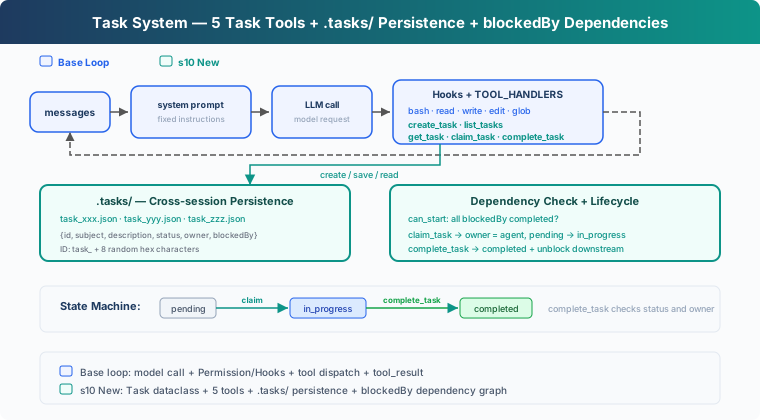
The code keeps S04's five base tools, Permission, Hooks, and shared execute_tool, then adds 5 task tools, persistence in the .tasks/ directory, and blockedBy dependency checks.
TodoWrite vs Task System:
| | TodoWrite (s05) | Task System (s10) | |---|---|---| | Role | Execution checklist for the current task | Recoverable task system | | Storage | In-process / session state | .tasks/{id}.json | | Dependencies | None | blockedBy dependency graph | | Lifecycle | Current session / current task | Cross-session | | Coordination | No task claiming | owner / claim | | Status | pending / in_progress / completed | pending / in_progress / completed | | Granularity | The agent's own steps | Tasks that can be claimed, tracked, and unblocked | | Update contract | Replace the whole checklist | Create/get/update/list individual records |
How It Works
Task: Data Structure
Each task is a JSON file, stored in the .tasks/ directory:
@dataclass
class Task:
    id: str
    subject: str
    description: str
    status: str          # pending | in_progress | completed
    owner: str | None    # Agent responsible for this task
    blockedBy: list[str] # List of dependency task IDs
IDs use the task_ prefix followed by 8 random hexadecimal characters. Files are created exclusively; an existing ID is discarded and regenerated.
TaskStore validates task IDs and reads and writes the JSON files. TASKS = TaskStore(TASKS_DIR) is the store used by this chapter.
create_task: Create Tasks
def create_task(subject: str, description: str = "",
                blockedBy: list[str] | None = None) -> Task:
    return TASKS.create(subject, description, blockedBy)
TaskStore.create checks the subject and dependency IDs, then writes .tasks/{id}.json. blockedBy declares dependencies; for example, "write API" can reference the database task's ID.
can_start: Dependency Check
A task can only start after all its blockedBy dependencies are completed:
def can_start(task_id: str) -> bool:
    return not incomplete_dependencies(load_task(task_id))
incomplete_dependencies loads each prerequisite. A task cannot be claimed if any prerequisite is not completed or its file no longer exists.
claim_task: Claim a Task
When the agent starts working on a task, it calls claim_task: sets owner, changes status from pending → in_progress. The owner field records who claimed the task:
def claim_task(task_id: str, owner: str = "agent") -> str:
    task = load_task(task_id)
    if task.status != "pending":
        return f"Task {task_id} is {task.status}, cannot claim"
    dependencies = incomplete_dependencies(task)
    if dependencies:
        return f"Blocked by: {dependencies}"
    task.owner = owner
    task.status = "in_progress"
    TASKS.save(task)
    return f"Claimed {task_id} ({task.subject})"
The claim is rejected if the task is not pending or its dependencies are incomplete. S10 only updates task state sequentially.
complete_task: Complete and Unblock
When a task is done, set it to completed. Simultaneously scan all other tasks to find downstream tasks that were just unblocked:
def complete_task(task_id: str, owner: str = "agent") -> str:
    task = load_task(task_id)
    if task.status != "in_progress":
        return f"Task {task_id} is {task.status}, cannot complete"
    if task.owner != owner:
        return f"Task {task_id} is owned by {task.owner}, not {owner}"
    ready_before = {t.id for t in list_tasks()
                    if t.status == "pending" and t.blockedBy
                    and can_start(t.id)}
    task.status = "completed"
    TASKS.save(task)
    unblocked = [t.subject for t in list_tasks()
                 if t.status == "pending" and t.blockedBy
                 and t.id not in ready_before
                 and can_start(t.id)]
    msg = f"Completed {task_id} ({task.subject})"
    if unblocked:
        msg += f"\nUnblocked: {', '.join(unblocked)}"
    return msg
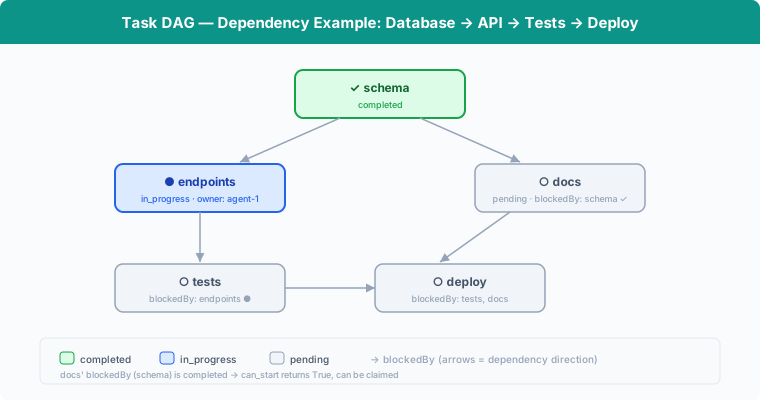
After completing "schema", can_start returns True for "endpoints" and "docs"; they can begin.
get_task: View Full Details
list_tasks only shows a one-line summary. get_task returns the full task JSON, including description and dependency details. When recovering across sessions, the agent needs to read the full description to continue work:
def get_task(task_id: str) -> str:
    task = load_task(task_id)
    return json.dumps(asdict(task), indent=2)
State Machine: Two Actions, Three States
pending ──claim──→ in_progress ──complete──→ completedHere claim / complete are actions, while pending / in_progress / completed are states:
- claim_task:
pending→in_progress. Sets owner, begins work. - complete_task:
in_progress→completed. Marks the task done and unblocks downstream.
Putting It Together
# Create tasks with dependencies
schema = create_task("setup database schema")
endpoints = create_task("create API endpoints", blockedBy=[schema.id])
tests = create_task("write tests", blockedBy=[endpoints.id])
docs = create_task("write docs", blockedBy=[schema.id])

# Agent claims the first available task
claim_task(schema.id)       # ✓ Claimed (no dependencies)
complete_task(schema.id)    # ✓ Completed → unblocks endpoints, docs

claim_task(endpoints.id)    # ✓ Claimed (schema completed)
complete_task(endpoints.id) # ✓ Completed → unblocks tests

claim_task(docs.id)         # ✓ Claimed (schema completed)
complete_task(docs.id)      # ✓ Completed

claim_task(tests.id)        # ✓ Claimed (endpoints completed)
complete_task(tests.id)     # ✓ Completed
Each create_task writes a JSON file, each claim_task / complete_task updates the file. Across sessions, the .tasks/ directory persists — the agent reads the files to recover progress.
Try It
cd learn-claude-code
python s10_task_system/code.py
Try these prompts:
Create tasks: setup database schema, create API endpoints (depends on schema), write tests (depends on endpoints), write docs (depends on schema)List all tasks and their statusesClaim the first unblocked task and complete itList tasks again — which ones are now unblocked?
What to observe: Are JSON files generated in the .tasks/ directory? After completing a task, are the blocked tasks unblocked?
What's Next
The task graph is in place, but full test suites, dependency installation, and deployment commands can take a long time. When these commands run synchronously, the Agent Loop remains blocked in the current tool call and cannot continue until the command finishes.
s11 Background Tasks → Slow operations run in the background. The Agent Loop can continue processing other tasks and receives a notification when the background work finishes.
S10 — Complete teaching code
#!/usr/bin/env python3
"""
s10_task_system.py - Task System

    .tasks/
      task_a1b2c3d4.json  {status: completed, blockedBy: []}
      task_e5f6a7b8.json  {status: pending, blockedBy: [task_a1b2c3d4]}
      task_11223344.json  {status: pending, blockedBy: [task_e5f6a7b8]}

    Dependency graph:

    +-----------+      +-----------+      +-----------+
    | schema    | ---> | API       | ---> | tests     |
    | completed |      | pending   |      | pending   |
    +-----------+      +-----------+      +-----------+

    can_start(API) is true because schema is completed.

    Task lifecycle:

    pending --claim_task--> in_progress --complete_task--> completed
"""

import glob
import json
import os
import re
import secrets
import subprocess
from dataclasses import asdict, dataclass
from pathlib import Path

try:
    import readline

    readline.parse_and_bind("set bind-tty-special-chars off")
    readline.parse_and_bind("set input-meta on")
    readline.parse_and_bind("set output-meta on")
    readline.parse_and_bind("set convert-meta off")
except ImportError:
    pass

from anthropic import Anthropic
from dotenv import load_dotenv

load_dotenv(override=True)
if os.getenv("ANTHROPIC_BASE_URL"):
    os.environ.pop("ANTHROPIC_AUTH_TOKEN", None)

WORKDIR = Path.cwd()
client = Anthropic(base_url=os.getenv("ANTHROPIC_BASE_URL"))
MODEL = os.environ["MODEL_ID"]

SYSTEM = (
    f"You are a coding agent at {WORKDIR}. "
    "Use task tools to track dependencies and progress."
)


# -- New in s10: persistent task records --

TASKS_DIR = WORKDIR / ".tasks"
TASK_ID_PATTERN = re.compile(r"^task_[0-9a-f]{8}$")


@dataclass
class Task:
    id: str
    subject: str
    description: str
    status: str
    owner: str | None
    blockedBy: list[str]


class TaskStore:
    def __init__(self, directory: Path):
        self.directory = directory

    def _root(self, create: bool = False) -> Path:
        if create:
            self.directory.mkdir(parents=True, exist_ok=True)
        root = self.directory.resolve()
        if not root.is_relative_to(WORKDIR.resolve()):
            raise ValueError("Task store escapes the workspace")
        return root

    def _path(self, task_id: str, create_root: bool = False) -> Path:
        if not isinstance(task_id, str) or not TASK_ID_PATTERN.fullmatch(task_id):
            raise ValueError(f"Invalid task ID: {task_id!r}")
        root = self._root(create=create_root)
        path = (root / f"{task_id}.json").resolve()
        if not path.is_relative_to(root):
            raise ValueError(f"Invalid task ID: {task_id!r}")
        return path

    def exists(self, task_id: str) -> bool:
        return self._path(task_id).is_file()

    def create(self, subject: str, description: str = "",
               blocked_by: list[str] | None = None) -> Task:
        subject = subject.strip()
        if not subject:
            raise ValueError("Task subject cannot be empty")

        dependencies = list(dict.fromkeys(blocked_by or []))
        for dependency in dependencies:
            if not self.exists(dependency):
                raise ValueError(f"Dependency not found: {dependency}")

        self._root(create=True)
        for _ in range(100):
            task = Task(
                id=f"task_{secrets.token_hex(4)}",
                subject=subject,
                description=description,
                status="pending",
                owner=None,
                blockedBy=dependencies,
            )
            try:
                with self._path(task.id, create_root=True).open(
                    "x", encoding="utf-8"
                ) as handle:
                    json.dump(asdict(task), handle, indent=2)
                return task
            except FileExistsError:
                continue
        raise RuntimeError("Could not allocate a unique task ID")

    def save(self, task: Task) -> None:
        self._path(task.id, create_root=True).write_text(
            json.dumps(asdict(task), indent=2),
            encoding="utf-8",
        )

    def load(self, task_id: str) -> Task:
        data = json.loads(self._path(task_id).read_text(encoding="utf-8"))
        task = Task(**data)
        if task.id != task_id:
            raise ValueError(f"Task file ID does not match {task_id}")
        if task.status not in ("pending", "in_progress", "completed"):
            raise ValueError(f"Invalid task status: {task.status}")
        return task

    def list(self) -> list[Task]:
        if not self.directory.exists():
            return []
        root = self._root()
        return [self.load(path.stem)
                for path in sorted(root.glob("task_*.json"))]


TASKS = TaskStore(TASKS_DIR)


def create_task(subject: str, description: str = "",
                blockedBy: list[str] | None = None) -> Task:
    return TASKS.create(subject, description, blockedBy)


def load_task(task_id: str) -> Task:
    return TASKS.load(task_id)


def list_tasks() -> list[Task]:
    return TASKS.list()


def get_task(task_id: str) -> str:
    return json.dumps(asdict(load_task(task_id)), indent=2)


def incomplete_dependencies(task: Task) -> list[str]:
    incomplete = []
    for dependency in task.blockedBy:
        try:
            if load_task(dependency).status != "completed":
                incomplete.append(dependency)
        except (FileNotFoundError, ValueError):
            incomplete.append(dependency)
    return incomplete


def can_start(task_id: str) -> bool:
    return not incomplete_dependencies(load_task(task_id))


def claim_task(task_id: str, owner: str = "agent") -> str:
    task = load_task(task_id)
    if task.status != "pending":
        return f"Task {task_id} is {task.status}, cannot claim"
    dependencies = incomplete_dependencies(task)
    if dependencies:
        return f"Blocked by: {dependencies}"
    task.owner = owner
    task.status = "in_progress"
    TASKS.save(task)
    print(f"  [claim] {task.subject} -> in_progress (owner: {owner})")
    return f"Claimed {task.id} ({task.subject})"


def complete_task(task_id: str, owner: str = "agent") -> str:
    task = load_task(task_id)
    if task.status != "in_progress":
        return f"Task {task_id} is {task.status}, cannot complete"
    if task.owner != owner:
        return f"Task {task_id} is owned by {task.owner}, not {owner}"
    ready_before = {
        candidate.id
        for candidate in list_tasks()
        if candidate.status == "pending"
        and candidate.blockedBy
        and can_start(candidate.id)
    }
    task.status = "completed"
    TASKS.save(task)
    unblocked = [candidate.subject for candidate in list_tasks()
                 if candidate.status == "pending"
                 and candidate.blockedBy
                 and candidate.id not in ready_before
                 and can_start(candidate.id)]
    print(f"  [complete] {task.subject}")
    message = f"Completed {task.id} ({task.subject})"
    if unblocked:
        message += f"\nUnblocked: {', '.join(unblocked)}"
        print(f"  [unblocked] {', '.join(unblocked)}")
    return message


# -- From s04: tool implementations --

def run_bash(command: str) -> str:
    try:
        result = subprocess.run(
            command,
            shell=True,
            cwd=WORKDIR,
            capture_output=True,
            text=True,
            timeout=120,
        )
        output = (result.stdout + result.stderr).strip()
        return output[:50000] if output else "(no output)"
    except subprocess.TimeoutExpired:
        return "Error: Timeout (120s)"


def run_read(path: str, limit: int | None = None) -> str:
    try:
        lines = (WORKDIR / path).resolve().read_text().splitlines()
        if limit and limit < len(lines):
            lines = lines[:limit] + [f"... ({len(lines) - limit} more lines)"]
        return "\n".join(lines)
    except Exception as error:
        return f"Error: {error}"


def run_write(path: str, content: str) -> str:
    try:
        file_path = (WORKDIR / path).resolve()
        file_path.parent.mkdir(parents=True, exist_ok=True)
        file_path.write_text(content)
        return f"Wrote {len(content)} bytes to {path}"
    except Exception as error:
        return f"Error: {error}"


def run_edit(path: str, old_text: str, new_text: str) -> str:
    try:
        file_path = (WORKDIR / path).resolve()
        text = file_path.read_text()
        if old_text not in text:
            return f"Error: text not found in {path}"
        file_path.write_text(text.replace(old_text, new_text, 1))
        return f"Edited {path}"
    except Exception as error:
        return f"Error: {error}"


def run_glob(pattern: str) -> str:
    try:
        matches = [
            match
            for match in glob.glob(pattern, root_dir=WORKDIR)
            if (WORKDIR / match).resolve().is_relative_to(WORKDIR)
        ]
        return "\n".join(matches) if matches else "(no matches)"
    except Exception as error:
        return f"Error: {error}"


def run_create_task(subject: str, description: str = "",
                    blockedBy: list[str] | None = None) -> str:
    task = create_task(subject, description, blockedBy)
    dependencies = (
        f" (blockedBy: {', '.join(task.blockedBy)})"
        if task.blockedBy else ""
    )
    print(f"  [create] {task.subject}{dependencies}")
    return f"Created {task.id}: {task.subject}{dependencies}"


def run_list_tasks() -> str:
    tasks = list_tasks()
    if not tasks:
        return "No tasks. Use create_task to add some."
    lines = []
    for task in tasks:
        marker = {
            "pending": "[ ]",
            "in_progress": "[>]",
            "completed": "[x]",
        }.get(task.status, "[?]")
        dependencies = (
            f" (blockedBy: {', '.join(task.blockedBy)})"
            if task.blockedBy else ""
        )
        owner = f" [{task.owner}]" if task.owner else ""
        lines.append(
            f"{marker} {task.id}: {task.subject} "
            f"[{task.status}]{owner}{dependencies}"
        )
    return "\n".join(lines)


def run_get_task(task_id: str) -> str:
    return get_task(task_id)


def run_claim_task(task_id: str) -> str:
    return claim_task(task_id, owner="agent")


def run_complete_task(task_id: str) -> str:
    return complete_task(task_id, owner="agent")


TOOLS = [
    {"name": "bash", "description": "Run a shell command.",
     "input_schema": {"type": "object", "properties": {"command": {"type": "string"}}, "required": ["command"]}},
    {"name": "read_file", "description": "Read file contents.",
     "input_schema": {"type": "object", "properties": {"path": {"type": "string"}, "limit": {"type": "integer"}}, "required": ["path"]}},
    {"name": "write_file", "description": "Write content to a file.",
     "input_schema": {"type": "object", "properties": {"path": {"type": "string"}, "content": {"type": "string"}}, "required": ["path", "content"]}},
    {"name": "edit_file", "description": "Replace exact text in a file once.",
     "input_schema": {"type": "object", "properties": {"path": {"type": "string"}, "old_text": {"type": "string"}, "new_text": {"type": "string"}}, "required": ["path", "old_text", "new_text"]}},
    {"name": "glob", "description": "Find files matching a glob pattern.",
     "input_schema": {"type": "object", "properties": {"pattern": {"type": "string"}}, "required": ["pattern"]}},
    {"name": "create_task", "description": "Create a task with optional dependencies.",
     "input_schema": {"type": "object", "properties": {"subject": {"type": "string"}, "description": {"type": "string"}, "blockedBy": {"type": "array", "items": {"type": "string"}}}, "required": ["subject"]}},
    {"name": "list_tasks", "description": "List tasks with status, owner, and dependencies.",
     "input_schema": {"type": "object", "properties": {}}},
    {"name": "get_task", "description": "Get a task by ID.",
     "input_schema": {"type": "object", "properties": {"task_id": {"type": "string"}}, "required": ["task_id"]}},
    {"name": "claim_task", "description": "Claim a pending task whose dependencies are complete.",
     "input_schema": {"type": "object", "properties": {"task_id": {"type": "string"}}, "required": ["task_id"]}},
    {"name": "complete_task", "description": "Complete the task claimed by this agent.",
     "input_schema": {"type": "object", "properties": {"task_id": {"type": "string"}}, "required": ["task_id"]}},
]

TOOL_HANDLERS = {
    "bash": run_bash,
    "read_file": run_read,
    "write_file": run_write,
    "edit_file": run_edit,
    "glob": run_glob,
    "create_task": run_create_task,
    "list_tasks": run_list_tasks,
    "get_task": run_get_task,
    "claim_task": run_claim_task,
    "complete_task": run_complete_task,
}


# -- From s04: hooks and permission checks --

HOOKS = {"UserPromptSubmit": [], "PreToolUse": [], "PostToolUse": [], "Stop": []}


def register_hook(event: str, callback):
    HOOKS[event].append(callback)


def trigger_hooks(event: str, *args):
    for callback in HOOKS[event]:
        result = callback(*args)
        if result is not None:
            return result
    return None


DENY_LIST = ["rm -rf /", "sudo", "shutdown", "reboot", "mkfs", "dd if="]
DESTRUCTIVE = ["rm ", "> /etc/", "chmod 777"]


def permission_hook(block):
    if block.name == "bash":
        command = block.input.get("command", "")
        for pattern in DENY_LIST:
            if pattern in command:
                print(f"\n\033[31m[blocked] '{pattern}'\033[0m")
                return "Permission denied by deny list"
        if any(keyword in command for keyword in DESTRUCTIVE):
            print("\n\033[33m[permission] Potentially destructive command\033[0m")
            print(f"   Tool: {block.name}({block.input})")
            choice = input("   Allow? [y/N] ").strip().lower()
            if choice not in ("y", "yes"):
                return "Permission denied by user"

    if block.name in ("read_file", "write_file", "edit_file"):
        path = block.input.get("path", "")
        if not (WORKDIR / path).resolve().is_relative_to(WORKDIR):
            print("\n\033[33m[permission] Access outside workspace\033[0m")
            print(f"   Tool: {block.name}({block.input})")
            choice = input("   Allow? [y/N] ").strip().lower()
            if choice not in ("y", "yes"):
                return "Permission denied by user"
    return None


def log_hook(block):
    preview = str(list(block.input.values())[:2])[:60]
    print(f"\033[90m[HOOK] {block.name}({preview})\033[0m")
    return None


def large_output_hook(block, output):
    if len(str(output)) > 100000:
        print(
            f"\033[33m[HOOK] Large output from {block.name}: "
            f"{len(str(output))} chars\033[0m"
        )
    return None


def context_hook(query: str):
    print(f"\033[90m[HOOK] UserPromptSubmit: working in {WORKDIR}\033[0m")
    return None


def summary_hook(messages: list):
    tool_count = sum(
        1
        for message in messages
        for block in (
            message.get("content")
            if isinstance(message.get("content"), list)
            else []
        )
        if isinstance(block, dict) and block.get("type") == "tool_result"
    )
    print(f"\033[90m[HOOK] Stop: session used {tool_count} tool calls\033[0m")
    return None


register_hook("UserPromptSubmit", context_hook)
register_hook("PreToolUse", permission_hook)
register_hook("PreToolUse", log_hook)
register_hook("PostToolUse", large_output_hook)
register_hook("Stop", summary_hook)


def execute_tool(block) -> str:
    blocked = trigger_hooks("PreToolUse", block)
    if blocked:
        return str(blocked)

    handler = TOOL_HANDLERS.get(block.name)
    try:
        output = handler(**block.input) if handler else f"Unknown: {block.name}"
    except Exception as error:
        output = f"Error: {error}"

    trigger_hooks("PostToolUse", block, output)
    return str(output)


# -- Agent loop --

def agent_loop(messages: list):
    while True:
        response = client.messages.create(
            model=MODEL,
            system=SYSTEM,
            messages=messages,
            tools=TOOLS,
            max_tokens=8000,
        )
        messages.append({"role": "assistant", "content": response.content})

        if response.stop_reason != "tool_use":
            force = trigger_hooks("Stop", messages)
            if force:
                messages.append({"role": "user", "content": force})
                continue
            return

        results = []
        for block in response.content:
            if block.type != "tool_use":
                continue
            output = execute_tool(block)
            results.append({
                "type": "tool_result",
                "tool_use_id": block.id,
                "content": output,
            })
        messages.append({"role": "user", "content": results})


if __name__ == "__main__":
    print("s10: Task System - dependencies and task state")
    print("Enter a question, press Enter to send. Type q to quit.\n")

    history = []
    while True:
        try:
            query = input("\033[36ms10 >> \033[0m")
        except (EOFError, KeyboardInterrupt):
            break
        if query.strip().lower() in ("q", "exit", ""):
            break
        trigger_hooks("UserPromptSubmit", query)
        history.append({"role": "user", "content": query})
        agent_loop(history)
        for block in history[-1]["content"]:
            if getattr(block, "type", None) == "text":
                print(block.text)
        print()
Try it — Task System scenario
A file-persisted task graph tracks status, ownership, and blockedBy dependencies.