S04. Hooks — Hang on the Loop, Don't Write into It
S04. Hooks — Hang on the Loop, Don't Write into It
The Problem
The s03 Agent has permission checks. But every new check, "log every bash call", "auto git add after writes", requires modifying the agent_loop function.
The loop quickly becomes this:
def agent_loop(messages):
    while True:
        # ... LLM call ...
        for block in response.content:
            if block.type != "tool_use":
                continue
            log_to_file(block)          # added a line
            check_permission(block)     # added a line
            notify_slack(block)         # added another line
            output = execute(block)
            auto_git_add(block)         # yet another line
            # ... the loop is unrecognizable
What you want to extend is the Agent's behavior, but what you're modifying is the loop itself. The loop should be a stable core; extensions should hang on the outside.
The Solution
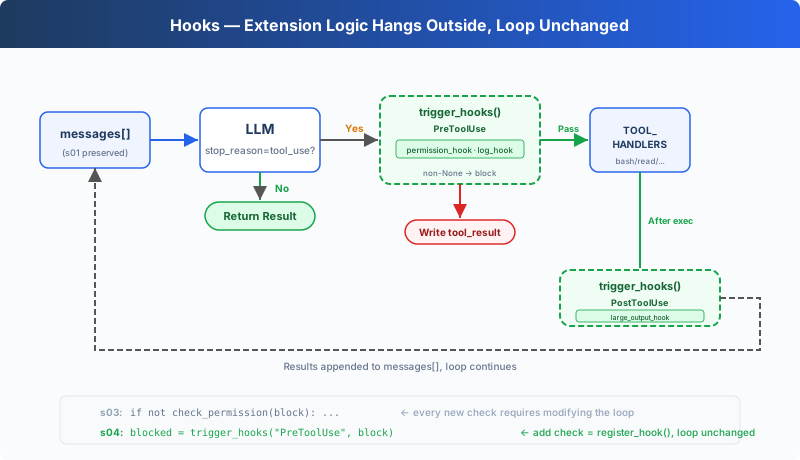
The s03 loop and permission logic are fully preserved. The only change is moving check_permission() from inside the loop body onto a hook. The loop no longer directly calls any check function. Instead it calls trigger_hooks("PreToolUse", block), and the registry decides what to run.
Four events, covering a complete agent cycle:
| Event | Trigger Timing | Typical Use | |-------|---------------|-------------| | UserPromptSubmit | After user input, before entering LLM | Input validation, context injection | | PreToolUse | Before tool execution | Permission checks, logging | | PostToolUse | After tool execution | Side effects (auto git add etc.), output checking | | Stop | When the loop is about to exit | Cleanup, decide whether the loop continues |
Extensions are added via register_hook(). The loop only calls trigger_hooks().
How It Works
Hook registry: a dict mapping event names to callback lists.
HOOKS = {
    "UserPromptSubmit": [],
    "PreToolUse": [],
    "PostToolUse": [],
    "Stop": [],
}

def register_hook(event: str, callback):
    HOOKS[event].append(callback)

def trigger_hooks(event: str, *args):
    for callback in HOOKS[event]:
        result = callback(*args)
        if result is not None:   # return value ≠ None → hook says "stop"
            return result
    return None
When PreToolUse returns non-None, the current tool execution is blocked. When Stop returns non-None, the loop continues. Return values from UserPromptSubmit and PostToolUse do not affect control flow.
UserPromptSubmit triggers after user input and before entering the LLM. The following hook records the current working directory:
def context_inject_hook(query: str) -> str | None:
    """Inject current working directory info into every prompt."""
    print(f"\033[90m[HOOK] UserPromptSubmit: working in {WORKDIR}\033[0m")
    return None   # return None = no modification, let prompt through

register_hook("UserPromptSubmit", context_inject_hook)
In the main loop, triggered right after user input:
query = input("s04 >> ")
trigger_hooks("UserPromptSubmit", query)   # ← before entering LLM
history.append({"role": "user", "content": query})
agent_loop(history)
PreToolUse / PostToolUse, hooks before and after tool execution. s03's permission check logic is now wrapped as a PreToolUse hook, plus a logging hook and a large-output reminder:
# PreToolUse: permission check (s03 logic, moved from loop to hook)
def permission_hook(block):
    if block.name == "bash":
        for pattern in DENY_LIST:
            if pattern in block.input.get("command", ""):
                return "Permission denied by deny list"
    if block.name in ("read_file", "write_file", "edit_file"):
        path = block.input.get("path", "")
        if not (WORKDIR / path).resolve().is_relative_to(WORKDIR):
            choice = input("   Allow? [y/N] ").strip().lower()
            if choice not in ("y", "yes"):
                return "Permission denied by user"
    return None

# PreToolUse: logging
def log_hook(block):
    print(f"[HOOK] {block.name}(...)")

# PostToolUse: large output reminder
def large_output_hook(block, output):
    if len(str(output)) > 100000:
        print(f"[HOOK] ⚠ Large output from {block.name}")

register_hook("PreToolUse", permission_hook)
register_hook("PreToolUse", log_hook)
register_hook("PostToolUse", large_output_hook)
Stop triggers when the loop is about to exit (stop_reason != "tool_use"). The following hook prints a cleanup summary:
def summary_hook(messages: list) -> str | None:
    """Print a summary when the loop is about to stop."""
    tool_count = sum(1 for m in messages
                     for b in (m.get("content") if isinstance(m.get("content"), list) else [])
                     if isinstance(b, dict) and b.get("type") == "tool_result")
    print(f"\033[90m[HOOK] Stop: session used {tool_count} tool calls\033[0m")
    return None   # return None = allow stop, return string = force continuation

register_hook("Stop", summary_hook)
In agent_loop, triggered before exit:
if response.stop_reason != "tool_use":
    force = trigger_hooks("Stop", messages)   # ← before exiting
    if force:
        # hook returned a message → inject it and continue
        messages.append({"role": "user", "content": force})
        continue
    return
Only one change in the loop: s03 directly called check_permission(block), s04 replaces it with trigger_hooks("PreToolUse", block):
for block in response.content:
    if block.type != "tool_use":
        continue

    # s03: if not check_permission(block): ...
    # s04: hooks replace hardcoding
    blocked = trigger_hooks("PreToolUse", block)
    if blocked:
        results.append({"type": "tool_result", "tool_use_id": block.id,
                        "content": str(blocked)})
        continue

    handler = TOOL_HANDLERS.get(block.name)
    output = handler(**block.input) if handler else f"Unknown: {block.name}"

    trigger_hooks("PostToolUse", block, output)

    results.append({"type": "tool_result", "tool_use_id": block.id,
                    "content": output})
Four hooks cover the critical nodes of the agent cycle: input → before execution → after execution → exit. The loop only calls trigger_hooks(); all logic lives in hook callbacks.
Changes from s03
| Component | Before (s03) | After (s04) | |-----------|-------------|-------------| | Extension method | check_permission() hardcoded in the loop | HOOKS registry + trigger_hooks() | | New functions | — | register_hook, trigger_hooks | | Hook callbacks | — | context_inject_hook, permission_hook, log_hook, large_output_hook, summary_hook | | Loop | Directly calls check_permission() | Calls trigger_hooks("PreToolUse", ...) | | Exit control | None | trigger_hooks("Stop", ...) can prevent exit | | Input interception | None | trigger_hooks("UserPromptSubmit", ...) can inject context |
Try It
cd learn-claude-code
python s04_hooks/code.py
Try these prompts:
Read the file README.md(should pass directly, observe hook logs)Create a file called test.txt(after creation, observe if PostToolUse fires)Delete all temporary files in /tmp(bash + rm triggers permission hook)
What to watch for: Before each tool execution, does the [HOOK] log appear? When permission is denied, was it intercepted by a hook or hardcoded in the loop?
What's Next
The Agent can now safely execute operations. But does it ever stop to think "what should I do first, and what next?" Given a complex task, does it jump straight in, or plan first?
→ s05 TodoWrite: Give the Agent a planning tool. Make a list first, then execute.
S04 — Complete teaching code
#!/usr/bin/env python3
"""
s04_hooks.py - Hooks

Hooks run callbacks at fixed points in the agent loop:

    User prompt
         |
         v
    UserPromptSubmit
         |
         v
    +----------+      +-------+      +------------+      +-------+
    | messages | ---> |  LLM  | ---> | PreToolUse | ---> | Tool  |
    +----------+      +---+---+      | permission |      +---+---+
         ^                | stop     | log        |          |
         |                v          +------------+          v
         |            Stop hook                         PostToolUse
         |                                               |
         +---------------- tool_result ------------------+
"""

import os
import subprocess
from pathlib import Path

try:
    import readline
    readline.parse_and_bind('set bind-tty-special-chars off')
    readline.parse_and_bind('set input-meta on')
    readline.parse_and_bind('set output-meta on')
    readline.parse_and_bind('set convert-meta off')
except ImportError:
    pass

from anthropic import Anthropic
from dotenv import load_dotenv

load_dotenv(override=True)
if os.getenv("ANTHROPIC_BASE_URL"):
    os.environ.pop("ANTHROPIC_AUTH_TOKEN", None)

WORKDIR = Path.cwd()
client = Anthropic(base_url=os.getenv("ANTHROPIC_BASE_URL"))
MODEL = os.environ["MODEL_ID"]

SYSTEM = f"You are a coding agent at {WORKDIR}. Use tools to solve tasks. Act, don't explain."


# -- From s02-s03: tool implementations --

def run_bash(command: str) -> str:
    try:
        r = subprocess.run(command, shell=True, cwd=WORKDIR,
                           capture_output=True, text=True, timeout=120)
        out = (r.stdout + r.stderr).strip()
        return out[:50000] if out else "(no output)"
    except subprocess.TimeoutExpired:
        return "Error: Timeout (120s)"

def run_read(path: str, limit: int | None = None) -> str:
    try:
        file_path = (WORKDIR / path).resolve()
        lines = file_path.read_text().splitlines()
        if limit and limit < len(lines):
            lines = lines[:limit] + [f"... ({len(lines) - limit} more lines)"]
        return "\n".join(lines)
    except Exception as e:
        return f"Error: {e}"

def run_write(path: str, content: str) -> str:
    try:
        file_path = (WORKDIR / path).resolve()
        file_path.parent.mkdir(parents=True, exist_ok=True)
        file_path.write_text(content)
        return f"Wrote {len(content)} bytes to {path}"
    except Exception as e:
        return f"Error: {e}"

def run_edit(path: str, old_text: str, new_text: str) -> str:
    try:
        file_path = (WORKDIR / path).resolve()
        text = file_path.read_text()
        if old_text not in text:
            return f"Error: text not found in {path}"
        file_path.write_text(text.replace(old_text, new_text, 1))
        return f"Edited {path}"
    except Exception as e:
        return f"Error: {e}"

def run_glob(pattern: str) -> str:
    import glob as g
    try:
        results = []
        for match in g.glob(pattern, root_dir=WORKDIR):
            if (WORKDIR / match).resolve().is_relative_to(WORKDIR):
                results.append(match)
        return "\n".join(results) if results else "(no matches)"
    except Exception as e:
        return f"Error: {e}"

TOOLS = [
    {"name": "bash", "description": "Run a shell command.",
     "input_schema": {"type": "object", "properties": {"command": {"type": "string"}}, "required": ["command"]}},
    {"name": "read_file", "description": "Read file contents.",
     "input_schema": {"type": "object", "properties": {"path": {"type": "string"}, "limit": {"type": "integer"}}, "required": ["path"]}},
    {"name": "write_file", "description": "Write content to a file.",
     "input_schema": {"type": "object", "properties": {"path": {"type": "string"}, "content": {"type": "string"}}, "required": ["path", "content"]}},
    {"name": "edit_file", "description": "Replace exact text in a file once.",
     "input_schema": {"type": "object", "properties": {"path": {"type": "string"}, "old_text": {"type": "string"}, "new_text": {"type": "string"}}, "required": ["path", "old_text", "new_text"]}},
    {"name": "glob", "description": "Find files matching a glob pattern.",
     "input_schema": {"type": "object", "properties": {"pattern": {"type": "string"}}, "required": ["pattern"]}},
]

TOOL_HANDLERS = {
    "bash": run_bash, "read_file": run_read, "write_file": run_write,
    "edit_file": run_edit, "glob": run_glob,
}


# -- New in s04: hook system (s03 permission logic now uses hooks) --

HOOKS = {"UserPromptSubmit": [], "PreToolUse": [], "PostToolUse": [], "Stop": []}

def register_hook(event: str, callback):
    HOOKS[event].append(callback)

def trigger_hooks(event: str, *args):
    for callback in HOOKS[event]:
        result = callback(*args)
        if result is not None:  # A hook result blocks this tool call.
            return result
    return None


# s03 permission check logic, now wrapped as a hook
DENY_LIST = ["rm -rf /", "sudo", "shutdown", "reboot", "mkfs", "dd if="]
DESTRUCTIVE = ["rm ", "> /etc/", "chmod 777"]

def permission_hook(block):
    """PreToolUse: s03 check_permission() logic moved here."""
    if block.name == "bash":
        for pattern in DENY_LIST:
            if pattern in block.input.get("command", ""):
                print(f"\n\033[31m[blocked] '{pattern}'\033[0m")
                return "Permission denied by deny list"
        for kw in DESTRUCTIVE:
            if kw in block.input.get("command", ""):
                print(f"\n\033[33m[permission] Potentially destructive command\033[0m")
                print(f"   Tool: {block.name}({block.input})")
                choice = input("   Allow? [y/N] ").strip().lower()
                if choice not in ("y", "yes"):
                    return "Permission denied by user"
    if block.name in ("read_file", "write_file", "edit_file"):
        path = block.input.get("path", "")
        if not (WORKDIR / path).resolve().is_relative_to(WORKDIR):
            print(f"\n\033[33m[permission] Access outside workspace\033[0m")
            print(f"   Tool: {block.name}({block.input})")
            choice = input("   Allow? [y/N] ").strip().lower()
            if choice not in ("y", "yes"):
                return "Permission denied by user"
    return None

def log_hook(block):
    """PreToolUse: log every tool call."""
    args_preview = str(list(block.input.values())[:2])[:60]
    print(f"\033[90m[HOOK] {block.name}({args_preview})\033[0m")
    return None

def large_output_hook(block, output):
    """PostToolUse: warn on large output."""
    if len(str(output)) > 100000:
        print(f"\033[33m[HOOK] Large output from {block.name}: {len(str(output))} chars\033[0m")
    return None

# UserPromptSubmit hook: log user input before it reaches the LLM
def context_inject_hook(query: str):
    print(f"\033[90m[HOOK] UserPromptSubmit: working in {WORKDIR}\033[0m")
    return None

# Stop hook: print summary when loop is about to exit
def summary_hook(messages: list):
    tool_count = sum(1 for m in messages
                     for b in (m.get("content") if isinstance(m.get("content"), list) else [])
                     if isinstance(b, dict) and b.get("type") == "tool_result")
    print(f"\033[90m[HOOK] Stop: session used {tool_count} tool calls\033[0m")
    return None

register_hook("UserPromptSubmit", context_inject_hook)
register_hook("PreToolUse", permission_hook)
register_hook("PreToolUse", log_hook)
register_hook("PostToolUse", large_output_hook)
register_hook("Stop", summary_hook)


# -- Agent loop: same structure as s03, but no hard-coded check --
# s03: if not check_permission(block): ...
# s04: if trigger_hooks("PreToolUse", block): ...

def agent_loop(messages: list):
    while True:
        response = client.messages.create(
            model=MODEL, system=SYSTEM, messages=messages,
            tools=TOOLS, max_tokens=8000,
        )
        messages.append({"role": "assistant", "content": response.content})

        if response.stop_reason != "tool_use":
            force = trigger_hooks("Stop", messages)
            if force:
                messages.append({"role": "user", "content": force})
                continue
            return

        results = []
        for block in response.content:
            if block.type != "tool_use":
                continue

            # s04 change: hook replaces hard-coded check_permission()
            blocked = trigger_hooks("PreToolUse", block)
            if blocked:
                results.append({"type": "tool_result", "tool_use_id": block.id,
                                "content": str(blocked)})
                continue

            handler = TOOL_HANDLERS.get(block.name)
            output = handler(**block.input) if handler else f"Unknown: {block.name}"

            trigger_hooks("PostToolUse", block, output)  # s04: post hook

            results.append({"type": "tool_result", "tool_use_id": block.id, "content": output})

        messages.append({"role": "user", "content": results})


if __name__ == "__main__":
    print("s04: Hooks - extension logic on hooks, loop stays clean")
    print("Enter a question, press Enter to send. Type q to quit.\n")

    history = []
    while True:
        try:
            query = input("\033[36ms04 >> \033[0m")
        except (EOFError, KeyboardInterrupt):
            break
        if query.strip().lower() in ("q", "exit", ""):
            break
        trigger_hooks("UserPromptSubmit", query)
        history.append({"role": "user", "content": query})
        agent_loop(history)
        for block in history[-1]["content"]:
            if getattr(block, "type", None) == "text":
                print(block.text)
        print()
Try it — Hooks scenario
Lifecycle hooks attach logging, permission, and output handling around the same stable agent loop.