
S02. Tool Use — Add a Tool, Add Just One Line
S02. Tool Use — Add a Tool, Add Just One Line
Only One Tool: Bash
The s01 Agent has only one tool: bash. To read a file, cat; to write, echo "..." > file.py; to edit, sed.
The model thinks "read this file" but has to spell out cat path/to/file. An extra layer of translation that wastes tokens and invites errors.
Overview: Tool Dispatch
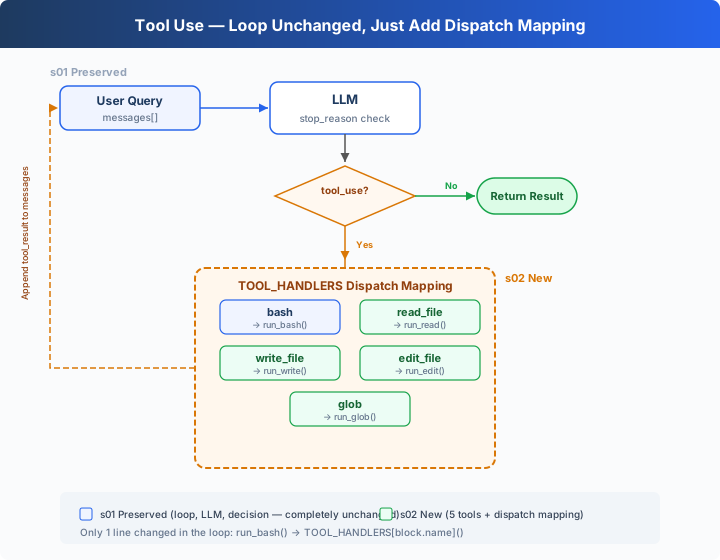
The s01 loop is fully preserved (LLM call, stop_reason check, message append — not a single word changed). The only change is in that one line of tool execution: run_bash() is replaced with TOOL_HANDLERS[block.name]() dispatch lookup.
Adding a tool to the Agent requires just two things:
- Define the tool: Add one entry to the
TOOLSarray - Register the handler: Add one mapping in the
TOOL_HANDLERSdict
From 1 Tool to 5 Tools
s01 had only bash:
TOOLS = [{"name": "bash", ...}]

def run_bash(command): ...
s02 expands to 5 tools, each independently defined:
TOOLS = [
    {"name": "bash",       "description": "Run a shell command.", ...},
    {"name": "read_file",  "description": "Read file contents.",  ...},
    {"name": "write_file", "description": "Write content to file.", ...},
    {"name": "edit_file",  "description": "Replace text in file once.", ...},
    {"name": "glob",       "description": "Find files by pattern.", ...},
]
Each tool has its own implementation function:
def run_read(path, limit=None):
    lines = safe_path(path).read_text().splitlines()
    if limit:
        lines = lines[:limit]
    return "\n".join(lines)

def run_write(path, content):
    safe_path(path).write_text(content)
    return f"Wrote {len(content)} bytes to {path}"

def run_edit(path, old_text, new_text):
    text = safe_path(path).read_text()
    if old_text not in text:
        return "Error: text not found"
    safe_path(path).write_text(text.replace(old_text, new_text, 1))
    return f"Edited {path}"

def run_glob(pattern):
    import glob as g
    return "\n".join(g.glob(pattern, root_dir=WORKDIR))
Tool Dispatch
TOOL_HANDLERS = {
    "bash":       run_bash,
    "read_file":  run_read,
    "write_file": run_write,
    "edit_file":  run_edit,
    "glob":       run_glob,
}

# Only one line changed in the loop — from hardcoded run_bash to dispatch lookup:
for block in response.content:
    if block.type == "tool_use":
        handler = TOOL_HANDLERS[block.name]    # lookup
        output = handler(**block.input)         # call
        results.append(...)
Adding a tool = one entry in TOOLS array + one line in TOOL_HANDLERS dict. The loop stays the same.
Multiple Tool Calls
The model often returns multiple tool_use calls at once — "read a.py and b.py, then list all .py files".
Calls are executed one by one in their original response.content order.
Quick Reference
| Concept | One-Liner | |---------|-----------| | TOOL_HANDLERS | Tool name → handler function dict. Add a tool = add one mapping line | | Tool Definition | JSON schema telling the model "what I can do" | | Multiple tool calls | Model may return multiple tool_use at once; calls execute in their original order | | Loop Unchanged | s01's while True loop — not a single line changed |
Changes from s01
| Component | Before (s01) | After (s02) | |-----------|-------------|-------------| | Tool count | 1 (bash) | 5 (+read, write, edit, glob) | | Tool execution | Hardcoded run_bash() | TOOL_HANDLERS dispatch lookup | | Path safety | None | safe_path validation (file tools only) | | Loop | while True + stop_reason | Identical to s01 |
Try It
cd learn-claude-code
python s02_tool_use/code.py
Try these prompts:
Read the file README.md and tell me what this project is aboutCreate a file called test.py that prints "hello", then read it backFind all Python files in this directoryRead both README.md and requirements.txt, then create a summary file
What to watch for: When does the model call just one tool, and when does it call multiple at once? Are multiple tool calls executed in the correct order?
What's Next
The Agent now has 5 specialized tools. File tools are protected by safe_path, but bash is unrestricted — rm -rf / still runs.
→ s03 Permission: Add a gate before tool execution — is this operation safe? Does it need user approval?
S02 — Complete teaching code
#!/usr/bin/env python3
"""
s02_tool_use.py - Tools

The agent loop from s01 does not change. This lesson adds four tools
and a dispatch map:

    +----------+      +-------+      +--------------------------+
    |   User   | ---> |  LLM  | ---> | Tool Dispatch            |
    |  prompt  |      |       |      | bash       -> run_bash   |
    +----------+      +---+---+      | read_file  -> run_read   |
                          ^          | write_file -> run_write  |
                          |          | edit_file  -> run_edit   |
                          +----------+ glob       -> run_glob   |
                          tool_result+--------------------------+

  + run_read / run_write / run_edit / run_glob
  + TOOL_HANDLERS instead of a hard-coded run_bash call
  + safe_path to keep file tools inside the workspace

Key insight: the loop stays the same; only tool registration and dispatch grow.
"""

import os
import subprocess
from pathlib import Path

try:
    import readline
    readline.parse_and_bind('set bind-tty-special-chars off')
    readline.parse_and_bind('set input-meta on')
    readline.parse_and_bind('set output-meta on')
    readline.parse_and_bind('set convert-meta off')
except ImportError:
    pass

from anthropic import Anthropic
from dotenv import load_dotenv

load_dotenv(override=True)
if os.getenv("ANTHROPIC_BASE_URL"):
    os.environ.pop("ANTHROPIC_AUTH_TOKEN", None)

WORKDIR = Path.cwd()
client = Anthropic(base_url=os.getenv("ANTHROPIC_BASE_URL"))
MODEL = os.environ["MODEL_ID"]

SYSTEM = f"You are a coding agent at {WORKDIR}. Use tools to solve tasks. Act, don't explain."


# -- From s01 (unchanged) --

def run_bash(command: str) -> str:
    dangerous = ["rm -rf /", "sudo", "shutdown", "reboot", "> /dev/"]
    if any(d in command for d in dangerous):
        return "Error: Dangerous command blocked"
    try:
        r = subprocess.run(command, shell=True, cwd=WORKDIR,
                           capture_output=True, text=True,
                           encoding="utf-8", errors="replace", timeout=120)
        out = (r.stdout + r.stderr).strip()
        return out[:50000] if out else "(no output)"
    except subprocess.TimeoutExpired:
        return "Error: Timeout (120s)"
    except (FileNotFoundError, OSError) as e:
        return f"Error: {e}"


# -- New in s02: four tools --

def safe_path(p: str) -> Path:
    path = (WORKDIR / p).resolve()
    if not path.is_relative_to(WORKDIR):
        raise ValueError(f"Path escapes workspace: {p}")
    return path


def run_read(path: str, limit: int | None = None) -> str:
    try:
        lines = safe_path(path).read_text().splitlines()
        if limit and limit < len(lines):
            lines = lines[:limit] + [f"... ({len(lines) - limit} more lines)"]
        return "\n".join(lines)
    except Exception as e:
        return f"Error: {e}"


def run_write(path: str, content: str) -> str:
    try:
        file_path = safe_path(path)
        file_path.parent.mkdir(parents=True, exist_ok=True)
        file_path.write_text(content)
        return f"Wrote {len(content)} bytes to {path}"
    except Exception as e:
        return f"Error: {e}"


def run_edit(path: str, old_text: str, new_text: str) -> str:
    try:
        file_path = safe_path(path)
        text = file_path.read_text()
        if old_text not in text:
            return f"Error: text not found in {path}"
        file_path.write_text(text.replace(old_text, new_text, 1))
        return f"Edited {path}"
    except Exception as e:
        return f"Error: {e}"


def run_glob(pattern: str) -> str:
    import glob as g
    try:
        results = []
        for match in g.glob(pattern, root_dir=WORKDIR):
            if (WORKDIR / match).resolve().is_relative_to(WORKDIR):
                results.append(match)
        return "\n".join(results) if results else "(no matches)"
    except Exception as e:
        return f"Error: {e}"


# -- New in s02: tool definitions (one tool in s01, five in s02) --

TOOLS = [
    {"name": "bash", "description": "Run a shell command.",
     "input_schema": {"type": "object", "properties": {"command": {"type": "string"}}, "required": ["command"]}},
    {"name": "read_file", "description": "Read file contents.",
     "input_schema": {"type": "object", "properties": {"path": {"type": "string"}, "limit": {"type": "integer"}}, "required": ["path"]}},
    {"name": "write_file", "description": "Write content to a file.",
     "input_schema": {"type": "object", "properties": {"path": {"type": "string"}, "content": {"type": "string"}}, "required": ["path", "content"]}},
    {"name": "edit_file", "description": "Replace exact text in a file once.",
     "input_schema": {"type": "object", "properties": {"path": {"type": "string"}, "old_text": {"type": "string"}, "new_text": {"type": "string"}}, "required": ["path", "old_text", "new_text"]}},
    {"name": "glob", "description": "Find files matching a glob pattern.",
     "input_schema": {"type": "object", "properties": {"pattern": {"type": "string"}}, "required": ["pattern"]}},
]

# -- New in s02: dispatch map (replaces s01's hard-coded run_bash call) --

TOOL_HANDLERS = {
    "bash": run_bash, "read_file": run_read, "write_file": run_write,
    "edit_file": run_edit, "glob": run_glob,
}


# -- The agent loop keeps the same shape as s01; only dispatch changes --
# s01: output = run_bash(block.input["command"])
# s02: output = TOOL_HANDLERS[block.name](**block.input)

def agent_loop(messages: list):
    while True:
        response = client.messages.create(
            model=MODEL, system=SYSTEM, messages=messages,
            tools=TOOLS, max_tokens=8000,
        )
        messages.append({"role": "assistant", "content": response.content})

        if response.stop_reason != "tool_use":
            return

        results = []
        for block in response.content:
            if block.type == "tool_use":
                print(f"\033[33m> {block.name}\033[0m")
                handler = TOOL_HANDLERS.get(block.name)
                output = handler(**block.input) if handler else f"Unknown: {block.name}"
                print(str(output)[:200])
                results.append({"type": "tool_result", "tool_use_id": block.id, "content": output})

        messages.append({"role": "user", "content": results})


if __name__ == "__main__":
    print("s02: Tool Use - four tools added to s01")
    print("Enter a question, press Enter to send. Type q to quit.\n")

    history = []
    while True:
        try:
            query = input("\033[36ms02 >> \033[0m")
        except (EOFError, KeyboardInterrupt):
            break
        if query.strip().lower() in ("q", "exit", ""):
            break
        history.append({"role": "user", "content": query})
        agent_loop(history)
        for block in history[-1]["content"]:
            if getattr(block, "type", None) == "text":
                print(block.text)
        print()
Try it — Tool Use scenario
Agent with read, write, edit, and bash tools