
S05. TodoWrite — An Agent Without a Plan Drifts Off Course
S05. TodoWrite — An Agent Without a Plan Drifts Off Course
The Problem
Give the Agent a complex task: "Rename all Python files to snake_case, run tests, and fix failures."
The Agent starts working, renames 3 files, runs a test, finds 2 failures, starts fixing. While fixing, it forgets the original goal was "rename to snake_case", the test failures have consumed all its attention.
The longer the conversation, the worse it gets: tool results keep filling the context, diluting the system prompt's influence. A 10-step refactoring: after steps 1-3, the Agent starts improvising because steps 4-10 have been pushed out of its attention.
The Solution
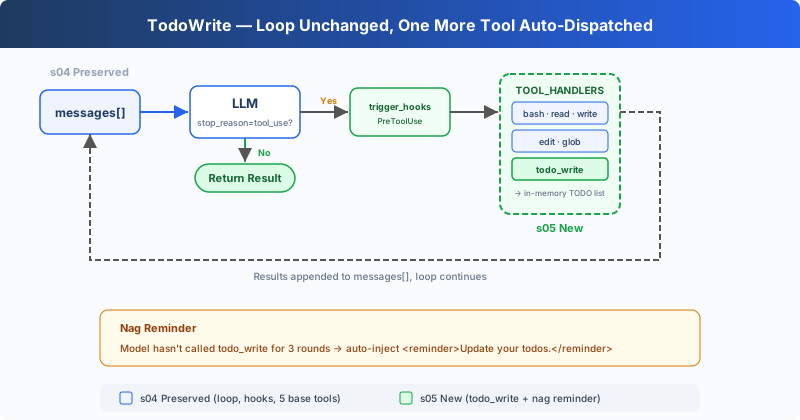
S05 keeps the tool dispatch, permissions, and hooks from S04, then adds todo_write and a reminder counter. todo_write only updates planning state; the existing tools still perform the work.
The new tool uses the same TOOL_HANDLERS[block.name] dispatch path. After three consecutive tool-use rounds without todo_write, the harness adds a reminder to that round's tool results.
How It Works
TodoManager owns the in-memory list, validates updates, and renders the state returned to the model. run_todo_write also prints that state in the terminal:
class TodoManager:
    def __init__(self):
        self.items = []

    def update(self, todos: list | str) -> str:
        # Parse and validate before replacing the current list.
        validated = []
        ...
        self.items = validated
        return self.render()

    def render(self) -> str:
        # [ ] pending, [>] in progress, [x] completed
        ...


TODO = TodoManager()

def run_todo_write(todos: list | str) -> str:
    output = TODO.update(todos)
    print(output)
    return output
An update may contain at most 20 items, each item needs non-empty content, and only one item may be in_progress. The string input path accepts JSON or a Python list representation without using eval.
The tool definition joins the other 5 in the dispatch map:
TOOLS = [
    {"name": "bash",       ...},
    {"name": "read_file",  ...},
    {"name": "write_file", ...},
    {"name": "edit_file",  ...},
    {"name": "glob",       ...},
    # s05: new entry
    {"name": "todo_write", "description": "Create and manage a task list ...",
     "input_schema": {
         "type": "object",
         "properties": {
             "todos": {
                 "type": "array",
                 "items": {
                     "type": "object",
                     "properties": {
                         "content": {"type": "string"},
                         "status": {"type": "string", "enum": ["pending", "in_progress", "completed"]},
                     },
                 },
             },
         },
     },
    },
]

TOOL_HANDLERS["todo_write"] = run_todo_writeReminder: after three tool-use rounds without todo_write, the reminder is appended to the third round's results and the counter resets:
rounds_since_todo = 0 if used_todo else rounds_since_todo + 1
if rounds_since_todo >= 3:
    results.append({
        "type": "text",
        "text": "<reminder>Update your todos.</reminder>",
    })
    rounds_since_todo = 0
Typical flow when the Agent receives a task: first call todo_write to list all steps (all pending) → pick one step, set it to in_progress → complete it, set to completed → look at the next pending → continue.
Key insight: todo_write doesn't give the Agent any additional execution capability. What it adds is planning capability.
Changes from s04
| Component | Before (s04) | After (s05) | |-----------|-------------|-------------| | Tool count | 5 (bash, read, write, edit, glob) | 6 (+todo_write) | | Planning | None | Stateful TODO list + reminder | | SYSTEM prompt | Generic prompt | Added "plan before executing" guidance | | Loop | Tool dispatch and hooks | Same dispatch path, plus rounds_since_todo and reminder injection |
Try It
cd learn-claude-code
python s05_todo_write/code.py
Try these prompts:
Refactor s05_todo_write/example/hello.py: add type hints, docstrings, and a main guard(should list 3 steps first, then execute)Create a Python package under s05_todo_write/example/demo_pkg with init.py, utils.py, and tests/test_utils.pyReview Python files under s05_todo_write/example and fix any style issues
What to watch for: Was the first tool call todo_write? How many TODO steps were listed? Did statuses move from pending to in_progress / completed during execution?
What's Next
The Agent can plan now. But if a task is too large, say "refactor the entire auth module", a TODO list alone isn't enough. That task is itself a collection of dozens of subtasks that would drown in a single conversation's context.
→ s06 Subagent: Break large tasks into subtasks, each handled by an independent Agent with its own clean context, no cross-contamination.
S05 — Complete teaching code
#!/usr/bin/env python3
"""
s05_todo_write.py - TodoWrite

The model tracks its progress through a TodoManager. After three rounds
without an update, the harness adds a reminder alongside the tool results.

    +----------+      +-------+      +--------------+
    |   User   | ---> |  LLM  | ---> | Tools        |
    |  prompt  |      |       |      | + todo_write |
    +----------+      +---^---+      +------+-------+
                          |                 | update
                          |          +------v----------+
                          |          | TodoManager     |
                          |          | [ ] pending     |
                          |          | [>] in progress |
                          |          | [x] completed   |
                          |          +------+----------+
                          | tool_result     |
                          +-----------------+

              rounds_since_todo >= 3 -> add <reminder>
"""

import ast
import json
import os
import subprocess
from pathlib import Path

try:
    import readline
    readline.parse_and_bind('set bind-tty-special-chars off')
except ImportError:
    pass

from anthropic import Anthropic
from dotenv import load_dotenv

load_dotenv(override=True)
if os.getenv("ANTHROPIC_BASE_URL"):
    os.environ.pop("ANTHROPIC_AUTH_TOKEN", None)

WORKDIR = Path.cwd()
client = Anthropic(base_url=os.getenv("ANTHROPIC_BASE_URL"))
MODEL = os.environ["MODEL_ID"]

# s05 change: SYSTEM prompt adds planning guidance
SYSTEM = (
    f"You are a coding agent at {WORKDIR}. "
    "Before starting any multi-step task, use todo_write to plan your steps. "
    "Update status as you go."
)


# -- Tool implementations from s02-s04 --

def run_bash(command: str) -> str:
    try:
        r = subprocess.run(command, shell=True, cwd=WORKDIR,
                           capture_output=True, text=True, timeout=120)
        out = (r.stdout + r.stderr).strip()
        return out[:50000] if out else "(no output)"
    except subprocess.TimeoutExpired:
        return "Error: Timeout (120s)"

def run_read(path: str, limit: int | None = None) -> str:
    try:
        lines = (WORKDIR / path).resolve().read_text().splitlines()
        if limit and limit < len(lines):
            lines = lines[:limit] + [f"... ({len(lines) - limit} more lines)"]
        return "\n".join(lines)
    except Exception as e:
        return f"Error: {e}"

def run_write(path: str, content: str) -> str:
    try:
        file_path = (WORKDIR / path).resolve()
        file_path.parent.mkdir(parents=True, exist_ok=True)
        file_path.write_text(content)
        return f"Wrote {len(content)} bytes to {path}"
    except Exception as e:
        return f"Error: {e}"

def run_edit(path: str, old_text: str, new_text: str) -> str:
    try:
        file_path = (WORKDIR / path).resolve()
        text = file_path.read_text()
        if old_text not in text:
            return f"Error: text not found in {path}"
        file_path.write_text(text.replace(old_text, new_text, 1))
        return f"Edited {path}"
    except Exception as e:
        return f"Error: {e}"

def run_glob(pattern: str) -> str:
    import glob as g
    try:
        results = []
        for match in g.glob(pattern, root_dir=WORKDIR):
            if (WORKDIR / match).resolve().is_relative_to(WORKDIR):
                results.append(match)
        return "\n".join(results) if results else "(no matches)"
    except Exception as e:
        return f"Error: {e}"


# -- New in s05: structured state the model updates --

class TodoManager:
    def __init__(self):
        self.items: list[dict] = []

    def update(self, todos: list | str) -> str:
        if isinstance(todos, str):
            try:
                todos = json.loads(todos)
            except json.JSONDecodeError:
                try:
                    todos = ast.literal_eval(todos)
                except (SyntaxError, ValueError) as e:
                    raise ValueError("todos must be a list or JSON array string") from e

        if not isinstance(todos, list):
            raise ValueError("todos must be a list")
        if len(todos) > 20:
            raise ValueError("Max 20 todos allowed")

        validated = []
        in_progress_count = 0
        for index, todo in enumerate(todos):
            if not isinstance(todo, dict):
                raise ValueError(f"todos[{index}] must be an object")

            content = str(todo.get("content", "")).strip()
            status = str(todo.get("status", "pending")).lower()
            if not content:
                raise ValueError(f"todos[{index}] requires content")
            if status not in ("pending", "in_progress", "completed"):
                raise ValueError(f"todos[{index}] has invalid status '{status}'")
            if status == "in_progress":
                in_progress_count += 1
            validated.append({"content": content, "status": status})

        if in_progress_count > 1:
            raise ValueError("Only one todo can be in_progress at a time")

        self.items = validated
        return self.render()

    def render(self) -> str:
        if not self.items:
            return "No todos."

        lines = []
        for todo in self.items:
            marker = {
                "pending": "[ ]",
                "in_progress": "[>]",
                "completed": "[x]",
            }[todo["status"]]
            lines.append(f"{marker} {todo['content']}")

        done = sum(todo["status"] == "completed" for todo in self.items)
        lines.append(f"\n({done}/{len(self.items)} completed)")
        return "\n".join(lines)


TODO = TodoManager()


def run_todo_write(todos: list | str) -> str:
    try:
        output = TODO.update(todos)
    except ValueError as e:
        return f"Error: {e}"
    print(f"\n\033[33m## Current Tasks\033[0m\n{output}")
    return output

TOOLS = [
    {"name": "bash", "description": "Run a shell command.",
     "input_schema": {"type": "object", "properties": {"command": {"type": "string"}}, "required": ["command"]}},
    {"name": "read_file", "description": "Read file contents.",
     "input_schema": {"type": "object", "properties": {"path": {"type": "string"}, "limit": {"type": "integer"}}, "required": ["path"]}},
    {"name": "write_file", "description": "Write content to a file.",
     "input_schema": {"type": "object", "properties": {"path": {"type": "string"}, "content": {"type": "string"}}, "required": ["path", "content"]}},
    {"name": "edit_file", "description": "Replace exact text in a file once.",
     "input_schema": {"type": "object", "properties": {"path": {"type": "string"}, "old_text": {"type": "string"}, "new_text": {"type": "string"}}, "required": ["path", "old_text", "new_text"]}},
    {"name": "glob", "description": "Find files matching a glob pattern.",
     "input_schema": {"type": "object", "properties": {"pattern": {"type": "string"}}, "required": ["pattern"]}},
    # s05: new tool
    {"name": "todo_write", "description": "Create and manage a task list for your current coding session.",
     "input_schema": {"type": "object", "properties": {"todos": {"type": "array", "maxItems": 20, "items": {"type": "object", "properties": {"content": {"type": "string", "minLength": 1}, "status": {"type": "string", "enum": ["pending", "in_progress", "completed"]}}, "required": ["content", "status"]}}}, "required": ["todos"]}},
]

TOOL_HANDLERS = {
    "bash": run_bash, "read_file": run_read, "write_file": run_write,
    "edit_file": run_edit, "glob": run_glob, "todo_write": run_todo_write,
}


# -- Hook system from s04 --

HOOKS = {"UserPromptSubmit": [], "PreToolUse": [], "PostToolUse": [], "Stop": []}

def register_hook(event: str, callback):
    HOOKS[event].append(callback)

def trigger_hooks(event: str, *args):
    for callback in HOOKS[event]:
        result = callback(*args)
        if result is not None:
            return result
    return None

DENY_LIST = ["rm -rf /", "sudo", "shutdown", "reboot", "mkfs", "dd if="]
DESTRUCTIVE = ["rm ", "> /etc/", "chmod 777"]

def permission_hook(block):
    """PreToolUse: s03 permission logic, registered as an s04 hook."""
    if block.name == "bash":
        command = block.input.get("command", "")
        for pattern in DENY_LIST:
            if pattern in command:
                print(f"\n\033[31m[blocked] '{pattern}'\033[0m")
                return "Permission denied by deny list"
        for keyword in DESTRUCTIVE:
            if keyword in command:
                print(f"\n\033[33m[permission] Potentially destructive command\033[0m")
                print(f"   Tool: {block.name}({block.input})")
                choice = input("   Allow? [y/N] ").strip().lower()
                if choice not in ("y", "yes"):
                    return "Permission denied by user"
    if block.name in ("read_file", "write_file", "edit_file"):
        path = block.input.get("path", "")
        if not (WORKDIR / path).resolve().is_relative_to(WORKDIR):
            print(f"\n\033[33m[permission] Access outside workspace\033[0m")
            print(f"   Tool: {block.name}({block.input})")
            choice = input("   Allow? [y/N] ").strip().lower()
            if choice not in ("y", "yes"):
                return "Permission denied by user"
    return None

def log_hook(block):
    """PreToolUse: log every tool call."""
    args_preview = str(list(block.input.values())[:2])[:60]
    print(f"\033[90m[HOOK] {block.name}({args_preview})\033[0m")
    return None

def large_output_hook(block, output):
    """PostToolUse: warn on large output."""
    if len(str(output)) > 100000:
        print(f"\033[33m[HOOK] Large output from {block.name}: {len(str(output))} chars\033[0m")
    return None

def context_inject_hook(query: str):
    """UserPromptSubmit: log working directory."""
    print(f"\033[90m[HOOK] UserPromptSubmit: working in {WORKDIR}\033[0m")
    return None

def summary_hook(messages: list):
    """Stop: print tool call count."""
    tool_count = sum(1 for m in messages
                     for b in (m.get("content") if isinstance(m.get("content"), list) else [])
                     if isinstance(b, dict) and b.get("type") == "tool_result")
    print(f"\033[90m[HOOK] Stop: session used {tool_count} tool calls\033[0m")
    return None

register_hook("UserPromptSubmit", context_inject_hook)
register_hook("PreToolUse", permission_hook)
register_hook("PreToolUse", log_hook)
register_hook("PostToolUse", large_output_hook)
register_hook("Stop", summary_hook)


# -- Agent loop with the reminder counter --

def agent_loop(messages: list):
    rounds_since_todo = 0
    while True:
        response = client.messages.create(
            model=MODEL, system=SYSTEM, messages=messages,
            tools=TOOLS, max_tokens=8000,
        )
        messages.append({"role": "assistant", "content": response.content})

        if response.stop_reason != "tool_use":
            force = trigger_hooks("Stop", messages)
            if force:
                messages.append({"role": "user", "content": force})
                continue
            return

        results = []
        used_todo = False
        for block in response.content:
            if block.type != "tool_use":
                continue

            blocked = trigger_hooks("PreToolUse", block)
            if blocked:
                results.append({"type": "tool_result", "tool_use_id": block.id,
                                "content": str(blocked)})
                continue

            handler = TOOL_HANDLERS.get(block.name)
            try:
                output = handler(**block.input) if handler else f"Unknown: {block.name}"
            except Exception as e:
                output = f"Error: {e}"

            trigger_hooks("PostToolUse", block, output)

            if block.name == "todo_write":
                used_todo = True

            results.append({"type": "tool_result", "tool_use_id": block.id,
                            "content": str(output)})

        rounds_since_todo = 0 if used_todo else rounds_since_todo + 1
        if rounds_since_todo >= 3:
            results.append({"type": "text",
                            "text": "<reminder>Update your todos.</reminder>"})
            rounds_since_todo = 0

        messages.append({"role": "user", "content": results})


if __name__ == "__main__":
    print("s05: TodoWrite - plan before execution")
    print("Enter a question, press Enter to send. Type q to quit.\n")

    history = []
    while True:
        try:
            query = input("\033[36ms05 >> \033[0m")
        except (EOFError, KeyboardInterrupt):
            break
        if query.strip().lower() in ("q", "exit", ""):
            break
        trigger_hooks("UserPromptSubmit", query)
        history.append({"role": "user", "content": query})
        agent_loop(history)
        for block in history[-1]["content"]:
            if getattr(block, "type", None) == "text":
                print(block.text)
        print()
Try it — TodoWrite scenario
A planning tool makes the agent's intended work visible and keeps long tasks from drifting.